« Isolation de la toiture et des combles. Différence ressentie dès l'hiver suivant. Petit retard de planning, mais résultat à la hauteur. »
Thomas R.Mons
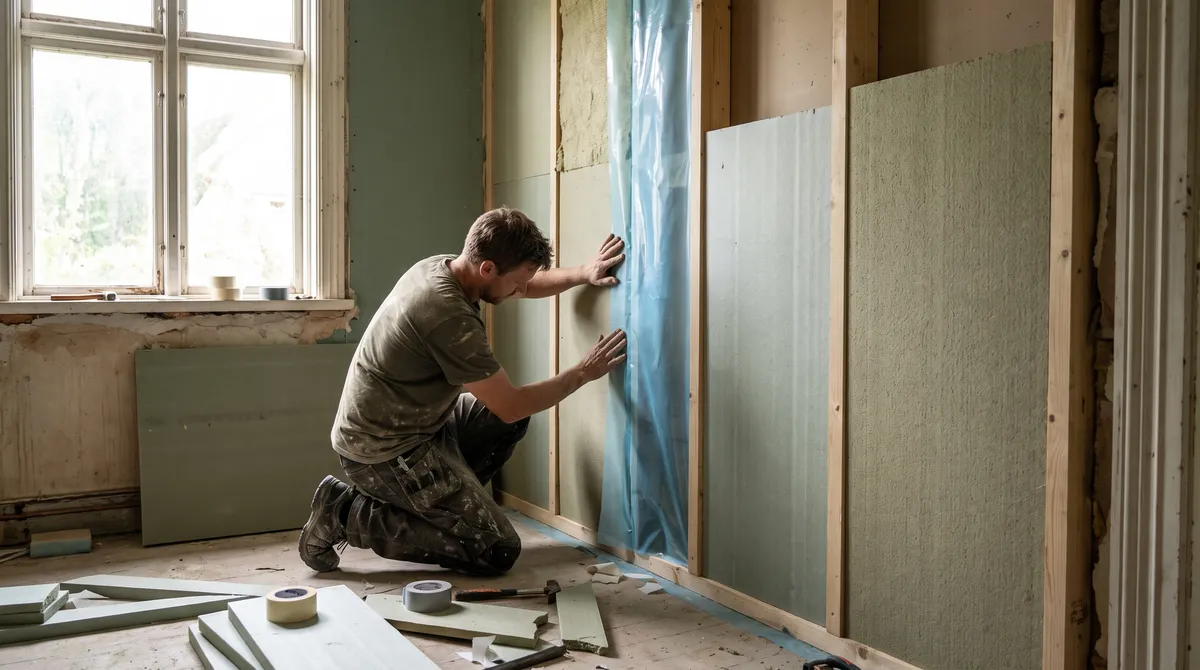
The solution when the outside is impossible: a listed or sound facade, a party wall, a co-ownership, or a room-by-room renovation. We apply a bonded insulated lining or a stud wall on a frame with a vapour barrier, on the inside. More accessible than exterior insulation, provided you take care with thermal bridges and airtightness.
The benchmarks that matter for a durable, condensation-free, well-fitted internal lining. Hard facts, not marketing.
We aim for an R of at least 3.5 m²K/W for a wall, ideally more depending on the space available. That is the value required by the regional grants: it is what governs eligibility, not the raw thickness.
Insulated lining + board, or frame + insulation + plasterboard + vapour barrier. This thickness is taken from the room: it is the main constraint of the solution, to anticipate on small spaces.
A continuous, sealed vapour barrier on the warm side stops water vapour reaching the cold wall and condensing there. It is the most delicate point: poorly fitted, it causes damp and mould behind the lining.
Cross-walls, floors and ceilings pass through the lining: these are cold zones where condensation concentrates. We address them with insulation returns to avoid stains and localised losses.
Mineral or wood wool on a frame, or a bonded lining composite (EPS, PU, polyurethane + board). The choice depends on the target thickness, the moisture regulation wanted and the budget.
Junctions with window frames, electrical sockets, service runs: every air leak degrades the result and creates a risk of condensation. Care in the workmanship makes all the difference with this technique.
* Indicative values for a standard renovation internal lining. The exact R depends on the insulant, the space available and the state of the wall — confirmed during the survey.
No solution is ideal everywhere. Here, honestly, is where internal insulation is the right call and where another technique is better.
It comes into its own whenever the outside is impossible or unwanted, and for renovations carried out in stages. A few typical cases:

Exposed brick, a listed facade or an imposed urban alignment: when you cannot touch the outside, internal insulation is the only option.

On a party wall or in a co-ownership, changing the facade is often impossible. The internal lining is decided and fitted in your own home, without the neighbour’s agreement.

Renovating a bedroom, a living room or an office? We insulate that room during the works, without committing the whole house or the budget of exterior insulation.
If the facade can be altered, exterior insulation remains the highest-performing (no thermal bridges, thermal mass kept). And if your walls have an empty cavity, cavity injection is unbeatable on price.


It was impossible to touch the fine listed brick facade of this town house. We fitted a stud wall on a frame with 12 cm of wool and a continuous vapour barrier, carefully addressing the cross-walls and the window surrounds. The bedroom went from a cold, damp wall to the comfort of a recent build.
4.5/5 · 2verified reviews
« Isolation de la toiture et des combles. Différence ressentie dès l'hiver suivant. Petit retard de planning, mais résultat à la hauteur. »
« Insufflation des murs creux, rapide et sans dégât. La prime régionale a couvert une bonne part. Maison nettement moins froide. »
Three ways to insulate a wall. Internal wins when the facade must stay intact; compare it with cavity injection and exterior insulation, then open the solution that fits you.
| Critère | Internal wall insulationVous êtes ici | Cavity injectionVoir la gamme → | Exterior insulationVoir la gamme → |
|---|---|---|---|
| Indicative price | €€ — affordable | The gentlest | €€€€ — the highest |
| Performance / thermal bridges | Good, bridges to address | Good if cavity suitable | Optimal, no bridges |
| Facade altered | No, interior only | No, by injection | Yes, new skin |
| Living space | Reduced (8–14 cm) | Unchanged | Unchanged |
| Thermal mass kept | No, wall outside the volume | Yes | Yes |
| Condensation risk | To manage (vapour barrier) | Low | Very low |
| Ideal for | Facade to keep, room by room | Existing cavity wall | High-performance deep renovation |
Every technique to insulate your walls compared on one page: internal, cavity, external. Enough to choose before requesting a quote.
Compare the techniques →If your walls have an empty cavity, injecting insulant is the fastest and cheapest, with no loss of floor space.
Discover cavity injection →Exterior insulation under render: maximum performance, no thermal bridges, while giving the facade a facelift.
See render insulation →Mineral or wood wool for your stud walls: performance, moisture regulation and acoustic comfort compared.
Choose your wool →An overview of the insulants you can fit on the inside: R, thickness, moisture behaviour and eco-footprint.
See the materials →Walls, roof, floor: the overview of our insulation solutions in Belgium, with grants and reduced VAT.
Back to the insulation guide →The price depends on the insulation thickness, the type of installation (bonded lining or frame) and the finishes. Here are some benchmarks for fitted internal insulation, with grants accounted for separately.
See the detailed price guide →* Indicative ranges per m² of insulated and fitted wall, excluding finishes (paint, skirting) and moving sockets. A firm figure is given with your free quote.
Whenever the facade cannot be altered: a listed facade, exposed brick to keep, a party wall, a co-ownership, or an imposed urban alignment. It is also the choice when renovating room by room or when the budget does not allow exterior insulation. If the facade can be touched, the outside remains higher-performing.
Between 8 and 14 cm per wall treated, depending on the insulation thickness and the technique. It is the main constraint of this solution: in a small bedroom, the loss of floor space is noticeable. We adapt the thickness to the target R and the space available.
Yes if the fitting is neglected, no if it is done well. The wall leaves the heated volume and becomes cold: without a continuous, sealed vapour barrier on the room side, water vapour can condense behind the lining. That is why we take care over the vapour barrier, the junctions and the treatment of thermal bridges.
Yes, most often. The lining brings the wall forward by several centimetres: sockets, switches and radiators have to be brought out to the new surface, and the service runs extended. We allow for these jobs in the quote to avoid nasty surprises.
The bonded lining (insulation composite + board) is fast and compact, ideal on a sound, flat wall. The stud wall on a metal frame leaves an air gap, accepts more insulation thickness and makes running services easier: it is preferable on an uneven wall or for a high R.
The regional grants depend on the R achieved (generally a required minimum) and not on the technique. Compliant internal insulation entitles you, depending on your region and income, to a renovation grant and to 6% VAT for homes over ten years old. We put the file together for you.
Free on-site survey, R and grants calculated, a single point of contact. Describe your project in under a minute.