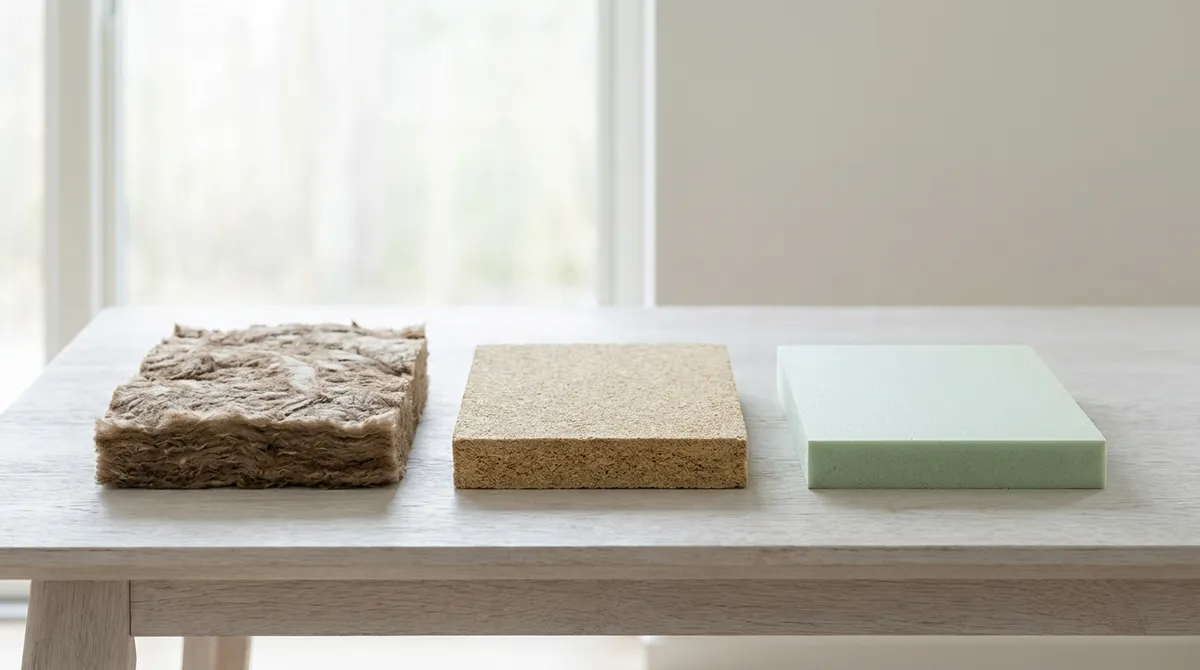
Insulating well means, first of all, choosing the right material for the right wall. A mineral wool, a bio-based insulant and a synthetic panel are not equivalent: they do not have the same insulating power, the same behaviour in the face of summer heat, or the same ecological footprint. There is no perfect insulant — only the one that suits your wall, the space available and your priorities. This guide helps you decide with full knowledge of the facts.
Three families of insulants
Almost all residential projects in Belgium rely on three main families. They all slow heat loss, but with very different trade-offs on price, thinness, summer comfort and ecological footprint.
Glass or rock: good performance-to-price, non-combustible, the most common solution.
Bio-based The eco choiceCellulose, wood fibre, hemp: excellent thermal lag and carbon footprint, healthy to fit.
Synthetics The thinnestPUR/PIR, EPS/XPS polystyrene: very low lambda, thin and high-performing, less eco-friendly.
Mineral wools: the good performance-to-price ratio
Glass wool and rock wool fit the vast majority of attics and walls in Belgium, and that is no accident. Their thermal conductivity (the famous lambda λ, in W/m·K) sits between 0.032 and 0.040, which places them at an excellent level for a contained price. They are non-combustible, easy to fit and widely available.
Their strengths
- Very good performance-to-price, the market’s economic benchmark
- Non-combustible (A1/A2 classification), a real asset for fire safety
- Available in rolls, panels or in blow-in flakes for unconverted attics
Their limits
Their main flaw is a low thermal lag: being light, they let the summer heat through quickly, which penalises summer comfort under the roof. They also fear moisture: compressed or wet, they lose part of their insulating power. Careful fitting, with a continuous vapour barrier, is essential.
This is the lambda of a good top-of-the-range glass wool. The lower the lambda, the more the insulant slows the heat at equal thickness: it is the first figure to compare on a quote, even before the thickness.
Bio-based: summer comfort and ecology
Cellulose wadding, wood fibre, hemp, wood wool: bio-based insulants come from renewable materials and show the best carbon footprint. Their lambda, between 0.038 and 0.042, is slightly behind mineral wools — but it is elsewhere that they make the difference.
Their master asset is thermal lag. Dense and heavy, they take ten to twelve hours to let the outside heat through, where a light wool gives way in four or five hours. The result: under an exposed roof, the bedroom stays liveable in the height of a heatwave. They also naturally regulate moisture, which keeps the walls healthy, and they are healthy to fit, with no irritation.
To keep in mind
- For an equivalent R, they need a few extra centimetres of thickness compared with synthetics
- Wood fibre in panels remains the most expensive option of the three families
- Blown cellulose wadding in unconverted attics, for its part, offers a formidable quality-to-price ratio
Unconverted attic, slopes, flat roof: each configuration calls for a different material and thickness. We review it wall by wall.
See roof insulation →Synthetics: performance in the fewest centimetres
Polyurethane (PUR/PIR) and polystyrene (expanded EPS, extruded XPS) play the thinness card. With a lambda among the lowest on the market — around 0.022 for PIR, 0.033 for XPS — they reach a high R in very little thickness. It is the decisive argument when space is tight: insulating a floor under screed, a terrace, or a wall from the outside where every centimetre counts.
XPS, moreover, resists moisture and compression very well, which makes it the benchmark under slab and in foundations.
Their limits
Their ecological footprint is the least favourable of the three families: materials derived from oil, hardly recyclable, and a mediocre thermal lag that does not protect at all against summer overheating. So they are reserved for the walls where their thinness is a real advantage, rather than the roof slopes where summer comfort comes first.
How to decide by wall
Rather than seeking “the best” insulant in the absolute, start from the wall to treat and your priorities. Four criteria are enough to bring out an obvious choice in most cases.
- The available space. If thickness is tight (floor, slopes, wall from the outside), a low-lambda synthetic reaches the target R without eating into the space.
- Summer comfort. Under an exposed roof, favour a dense bio-based (wood fibre, cellulose) for its thermal lag: it is what keeps the house cool.
- The budget. For unconverted attics or walls with no space constraint, mineral wools offer the best performance per euro.
- Ecology and health. If these criteria weigh in, bio-based stand out, with a superior carbon footprint and indoor air quality.
And nothing requires uniformity: it is common to blow cellulose into unconverted attics, fit wood fibre on slopes and a thin synthetic on the floor — each wall its own material.
2026 ranges per square metre by insulant and by wall, what makes the bill and the regional grants vary — with a worked example.
See the prices & grants guide →R, lambda, thermal lag: the three figures that count
Before signing a quote, look at three values. The lambda (λ) measures the material’s intrinsic insulating power: the lower it is, the better. The thermal resistance R combines this lambda and the thickness fitted (R = thickness / λ): it is what the grants and standards target, with goals of the order of R 4.5 in walls and R 6 to 7 in the roof. The thermal lag, finally, is not read off the winter performance but off summer comfort: it is what distinguishes a liveable bedroom from a furnace under the attic in July.
An insulant is never “good” in the absolute: it is good for a wall, an available thickness and a given priority. That is the whole challenge of a diagnosis before the project.
The recap in 30 seconds
- Mineral wools — the best performance-to-price, non-combustible, but low thermal lag.
- Bio-based — summer comfort and ecology: long thermal lag and moisture management, for a few extra centimetres.
- Synthetics — the lowest lambda, high R in little thickness, but a weaker ecological footprint.
- Compare the lambda first, then check the target R and the thermal lag by wall.
- When in doubt, a free diagnosis determines the right insulant wall by wall.
Guide verified in May 2026 · updated every year