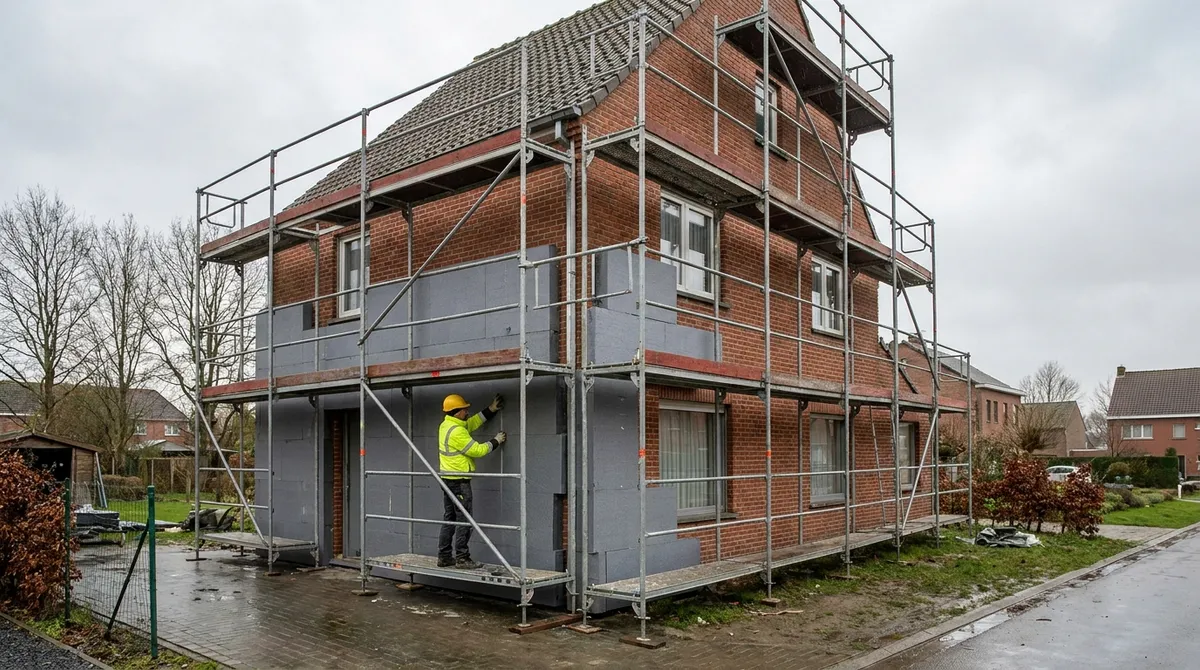
Year after year, insulation remains one of the renovation items best supported by public authorities in Belgium. The reason is simple: it is the measure that most durably reduces the energy bill, for an investment often recovered in a few years. You still have to find your way among the regional schemes, their amounts and their conditions. This guide reviews the grants for insulation in 2026, without promising figures set in stone: the scales change, and your personal situation remains decisive.
Three regions, three schemes
In Belgium, energy renovation aid does not depend on the federal State but on the regions. Where you live therefore determines the name of the scheme, the amounts and the process. First of all, identify the right gateway.
Wallonia: the Prime Habitation
In Wallonia, insulation is supported by the Prime Habitation, a single scheme that covers the roof, walls and floor. The amount is expressed per square metre insulated and varies by wall concerned: the roof, the walls (from the inside or the outside) and the floor do not give entitlement to the same support.
Two mechanisms shape the aid. First, an income-based adjustment for the household: the more modest the income, the higher the coefficient applied to the base amount. Then, for the largest amounts, a prior home audit carried out by an approved auditor is generally required. This audit draws up a full assessment and proposes a step-by-step renovation path, into which each set of works fits.
Brussels: Renolution
In the Brussels Region, renovation grants have been brought together under the Renolution banner. The scheme also covers the insulation of the roof, walls and floor, with amounts adjusted to household income and technical requirements specific to the region. The logic stays close to that of Wallonia: minimum performance to reach, use of a professional and putting together a file.
Flanders: Mijn VerbouwPremie
In Flanders, it is the Mijn VerbouwPremie that gathers renovation aid, including insulation. Here too, the amount depends on the nature of the works and the applicant’s income category. If your home is in Flanders, this is the desk to aim for.
That many separate schemes. The first reflex before quoting an insulation project is to identify your region: it determines the name of the grant, the amounts and the steps to follow.
Amounts per square metre, adjusted to your income
What the three regions have in common is the logic of the calculation. Support for insulation is not a single flat sum: it is most often expressed per square metre of wall insulated, with a base amount that depends on the wall treated.
- Roof — often the priority item, because a large share of the heat escapes through the top. Insulating the roof (or the attic floor) is among the best-supported works. To go further, see the roof insulation grant.
- Walls — external insulation and internal insulation are not always supported at the same level. The detail awaits you on the wall insulation grant.
- Floor — often less of a priority than the roof, but eligible when it genuinely improves the performance of the envelope.
On top of this base amount comes the income-based adjustment. In practice, the same square metre insulated does not give the same amount for a low-income household and for a higher-income household: a multiplier coefficient favours the former. It is a mechanism common to the three regions, even if the brackets and coefficients differ.
The choice of insulant affects both the performance reached and compliance with the minimum R required by the grants. Discover our insulation solutions, wall by wall.
See our insulation solutions →6% VAT: an often-forgotten boost
Alongside the regional grants, a federal benefit deserves attention: the reduced 6% VAT on renovation works. For a home over ten years old, insulation works carried out by a registered contractor qualify, in principle, for this reduced rate, instead of the usual 21%.
This benefit has two particularities. On one hand, it applies directly on the contractor’s invoice: you have no specific step to take, it is the professional who states the rate. On the other hand, it is, in principle, combinable with regional grants — which makes it a discreet but real saving lever on the final amount. Like any tax provision, its exact conditions are to be confirmed at the time of the works.
The conditions to meet
Whatever the region, an insulation grant is not triggered automatically. Three families of conditions come up everywhere, and neglecting them risks a refusal of the file.
A minimum performance (the R value)
Grants almost always require a minimum thermal resistance, expressed by an R value to reach depending on the wall. This value depends on the thickness and nature of the insulant installed. An insulant that is too thin, even if correctly fitted, can take the project below the threshold and make it ineligible. The choice of insulant and its thickness is therefore not just a question of comfort: it is a condition of entitlement.
A registered contractor
The works must be entrusted to a registered contractor. DIY, however careful, generally does not give entitlement to grants. Using a recognised professional also guarantees that the rules of good practice are followed and the quality of the work — two conditions for the expected thermal result.
A file and invoices in order
Finally, the file must be put together with care: detailed invoices stating the nature of the works, the areas, the insulant and its performance, and where applicable the audit report. In Wallonia, the prior home audit conditions access to the highest amounts and sets the works within a coherent renovation path.
The process, step by step
To give yourself every chance, it is better to follow a logical order rather than ordering the works and then looking for the grant afterwards.
- Identify your region and the applicable scheme (Prime Habitation, Renolution or Mijn VerbouwPremie).
- Carry out the audit if your project requires it, notably in Wallonia for large amounts.
- Choose a registered contractor and have a detailed quote drawn up that meets the minimum R required.
- Check the order of the steps: depending on the scheme, some aid assumes an application or an approval before the works begin.
- Keep all the invoices and put together the grant file within the deadlines.
Beyond insulation, other works give entitlement to regional aid. Find the grants overview to estimate the total support for your project.
See the grants overview →What is changing in 2026
The regional schemes are not fixed: every year, the regions adjust the scales, the income brackets and the technical requirements. The underlying trend, in 2026, remains the encouragement of step-by-step renovation, guided by the audit, and of ever-more-efficient walls.
In practice, this means that amounts announced at the start of the year can be revised, and that eligibility conditions can tighten or, on the contrary, broaden. That is why the figures in this guide are benchmarks, not promises: before starting your project, reconfirm the scale in force for your wall, your region and your income category. Personalised advice avoids many disappointments, because two neighbouring projects can give entitlement to very different amounts.
The recap in 30 seconds
- Insulation grants depend on your region: Prime Habitation (Wallonia), Renolution (Brussels), Mijn VerbouwPremie (Flanders).
- Support is most often expressed per m² by wall (roof, walls, floor) and is adjusted to your income.
- 6% VAT applies for renovation of a home over ten years old, via a registered contractor.
- Key conditions: minimum R, registered contractor, invoices in order — and a prior audit in Wallonia for large amounts.
- The scales change in 2026: treat the amounts as benchmarks and reconfirm them before the works.
2026 amounts · to reconfirm depending on your situation and your region