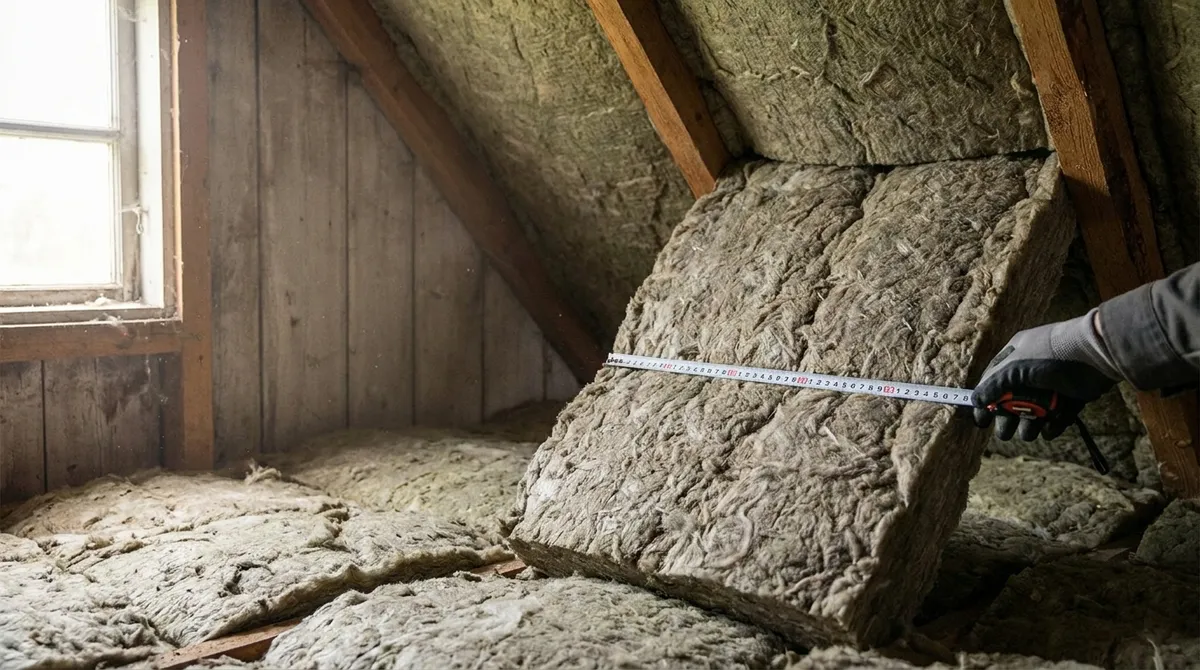
When it comes to insulating a loft, the first question is almost never the right one. People ask “what thickness?” before asking “what performance?” — when it is the other way around that matters. Thickness is only a means; the real goal, the one that decides your comfort and your grant, is the thermal resistance. This guide links the two to give you a clear figure to aim for, then the concrete centimetres to get there.
Thickness does not tell the whole story: enter the R-value
Two insulants of the same thickness can insulate very differently. What sets them apart is the thermal resistance R, expressed in m²K/W: the higher it is, the more the wall slows down heat. It is what appears on serious quotes and it is R, and not thickness alone, that the regions require to grant a subsidy.
The resistance is calculated simply:
R = thickness of the insulation (in metres) / λ (lambda)
The lambda (λ) is the material’s thermal conductivity: the lower it is, the better the insulant performs at equal thickness. A common glass wool shows a λ around 0.040 W/mK; a high-end wool drops to 0.032, even 0.030.
A worked example
The formula reverses to find the thickness: thickness = R × λ. To aim for R = 4.5 m²K/W, you can therefore read off the centimetres needed directly according to the wool chosen:
- standard wool at λ = 0.040 → 4.5 × 0.040 = 0.18 m, that is 18 cm of material alone; in real life, you go up to 30 to 35 cm once settling, the thermal bridges of the timber and the installation margins are factored in;
- high-performance wool at λ = 0.032 → 4.5 × 0.032 = 0.144 m; on site, you end up around 25 to 30 cm for the same resistance.
Remember the principle: at equal resistance, a better lambda saves centimetres — precious under a roof where space is tight.
The target to aim for: R ≥ 4.5 for the roof grant
In Wallonia, the roof insulation grant requires a minimum thermal resistance. The benchmark to keep in mind is clear.
This is the minimum thermal resistance targeted for the roof in Wallonia in order to qualify for the insulation grant. In practice, aiming a little above (R ≈ 5 to 6) only costs a few extra centimetres of wool, for lastingly superior comfort.
In concrete terms, this threshold translates into a thickness of around 30 to 40 cm of wool depending on the lambda chosen. There is no point aiming for the strict minimum: going from R 4.5 to R 6 calls for only about ten extra centimetres, free or almost free against the gain in comfort in winter as in summer. The exact conditions and amounts change every year.
Amounts, required R-value threshold and steps: the detail of the regional grant for roof insulation.
See the roof insulation grant →Why the roof comes first
If you could only insulate one wall, it would be the roof. The reason comes down to a simple law of physics: heat rises. In an old, poorly insulated house, nearly 30% of the thermal losses go through the roof — far more than through the walls or the windows taken separately.
It is therefore the project with the best return: the insulation thickness gained translates directly into lighter heating bills, and the return on investment is generally the fastest in the whole house. Before replacing a boiler or fitting triple glazing, insulate the roof.
Techniques, materials and performance to insulate your roof effectively, from the unconverted loft to insulation from the outside.
Discover roof insulation →Unconverted or converted loft: two techniques
The resistance to reach is the same everywhere, but the way to install the insulation changes depending on whether your loft is habitable or not.
Unconverted loft: blowing
When the loft is not converted, the most effective approach is to blow loose-fill wool directly over the loft floor. With no height constraint under the roof, you can easily reach 35, 40 cm, even more. It is the fastest technique, the most economical per square metre and the one that best covers the nooks of the roof structure, with no thermal bridge.
Converted loft: between and under the rafters
If you live under the loft, the insulation fits between the rafters then, ideally, under the rafters in a second cross layer to eliminate the thermal bridges of the timber. Here, the available height is limited: you then favour a wool with a low lambda (0.032 or better) to reach R ≥ 4.5 without eating into the whole living space. The double cross layer is the key to continuous, high-performance insulation.
The vapour barrier: the step you do not skip
Loft insulation without a vapour barrier is insulation on borrowed time. Installed on the warm side, towards the interior, the vapour barrier prevents the water vapour produced in the home (kitchen, shower, breathing) from migrating into the insulation and condensing there.
Without this barrier, the wool becomes damp, gradually loses its thermal resistance and the moisture ends up attacking the roof structure. The vapour barrier must be continuous, its sheets overlapping and carefully taped at the joins and the cable passages. It is an installation detail that is invisible once the work is finished, but decisive for the lifespan of the insulation.
Should you over-insulate?
Increasing the thickness beyond the grant threshold is often a good idea — but with discernment. Each extra centimetre improves the resistance, hence the comfort, particularly summer comfort: a good insulation thickness delays the entry of heat under the roof during heatwaves.
The return is nonetheless diminishing: going from R 4.5 to R 6 is very cost-effective; aiming for R 10 much less so. In an unconverted loft, where thickness costs almost nothing, do not hold back. In a converted loft, where every centimetre is taken from the living space, you calibrate the thickness according to the space and the lambda. In every case, the right reflex is to start from the R-value targeted, then deduce the centimetres — never the other way around.
Glass wool, rock wool, cellulose or wood fibre: their lambdas, their price and their summer comfort compared.
Compare the insulants →The 30-second recap
- You aim for a R-value, not a thickness: R = thickness / λ.
- Roof grant target in Wallonia: R ≥ 4.5 m²K/W, that is around 30 to 40 cm of wool.
- A lower lambda (0.032) reaches the same resistance with less thickness.
- The roof comes first: nearly 30% of the losses go through the roof.
- Unconverted loft = generous blowing; converted = between and under the rafters.
- Always a continuous vapour barrier on the warm side, on pain of moisture.
Guide verified in May 2026 · updated every year