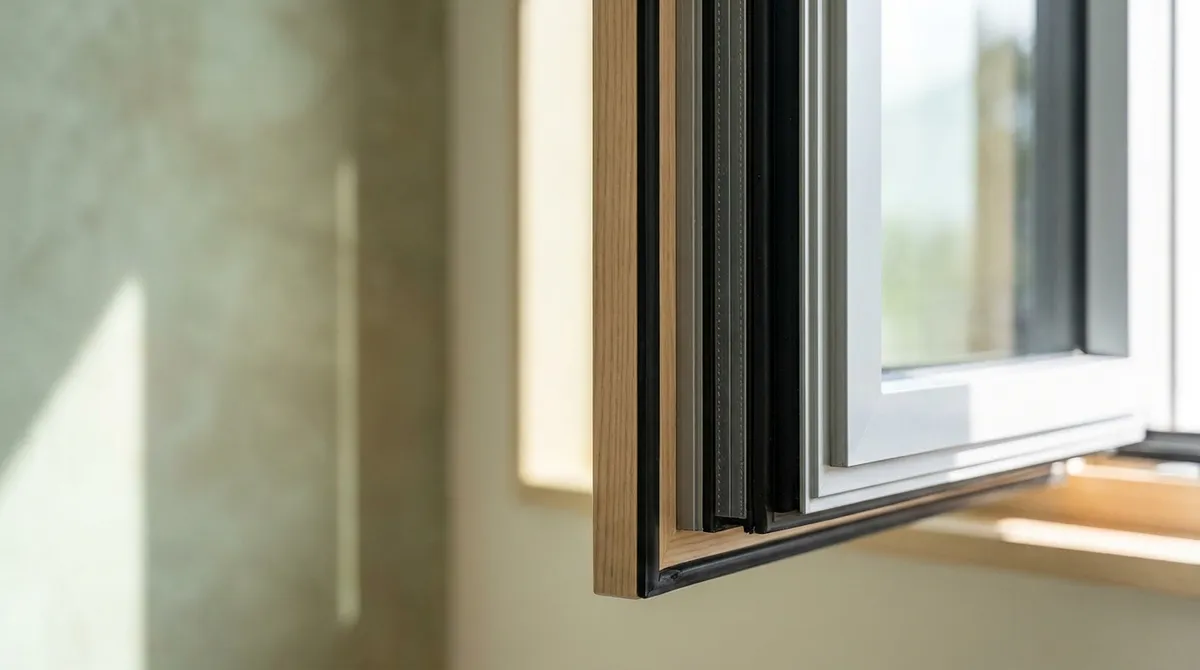
Faced with a window frame quote, we readily dwell on the material, the colour or the price. Yet it is a few discreet letters — Uw, Ug, Uf — that decide your comfort and your heating bill for the next twenty years. The good news: these coefficients are simpler than they look. One rule is enough to start with: the lower the figure, the better it insulates. Here is how to read them without slipping up.
One coefficient, one single idea: the heat that escapes
All these “thermal transmittance coefficients” measure the same thing: the amount of heat that passes through a wall, from warm to cold. The unit is the W/m²K — watts lost per square metre of surface and per degree of difference between inside and outside.
Keep the essential in mind: a coefficient of 1.3 lets out half as much heat as a coefficient of 2.6. Every tenth gained is heating saved and a wall that is warmer to the touch in winter — and therefore less of that cold-wall feeling near the window.
This is the target of a truly high-performance window frame in 2026. Above 1.5, insulation drops off and the renovation grant can fall away; below 1.3, you are among the very best.
Uw, Ug, Uf: which one measures what?
This is where many people get lost. Three subscript letters, three parts of the window. The distinction is simple once it is laid out.
Window: the overall performance of the window frame, glazing and frame combined. The only value to compare.
Ug The glazing aloneGlass: the insulation of the glazing alone. Double ~1.1; triple ~0.6. Often highlighted because it is flattering.
Uf The frame aloneFrame: the insulation of the frame alone (PVC, wood, thermally broken aluminium). More discreet on quotes.
Why the Uw is the only figure that really counts
The Uw (“U window”) is a weighted average of three elements: the glazing (Ug), the frame (Uf) and the spacer — the small bar that separates the panes of glass around their edge. A window never insulates better than its weakest part: that is why the Uw is almost always a little worse than the Ug alone.
In practice, a technical sheet may proudly display glazing with Ug = 0.6 but end up at Uw = 1.2 once the frame and the spacer are taken into account. Never compare two windows on the Ug alone: it is the classic trap of overly optimistic comparisons. The Uw, on the other hand, does not cheat — it describes the window as it will be installed in your home.
“The Ug is the glazing’s grade; the Uw is the grade on the full report card. It is the Uw you read to judge a window frame.
The (often forgotten) role of the frame and the spacer
An excellent triple glazing mounted on a mediocre frame will give a disappointing Uw. That is the whole point of the Uf: a multi-chamber PVC frame or a carefully designed thermally broken aluminium pulls the Uw down. Conversely, an old aluminium frame with no insulating bar drags down the whole, whatever the glazing.
The spacer counts too: so-called “warm edge” models (a warm edge, made of insulating material rather than aluminium) gain a few precious tenths on the Uw and limit condensation around the edge of the glazing. The choice of window frame material therefore weighs directly on these values — a subject covered in detail in our PVC, aluminium or wood-aluminium guide.
The g-factor: the heat that comes in for free
Alongside the U coefficients, which measure losses, there is a value that measures gains: the solar g-factor. Between 0 and 1, it indicates the share of solar energy that the glazing lets into the room. A g-factor of 0.6 means that 60% of the sun’s heat is transmitted.
This is an important subtlety: glazing that insulates very well (low Ug) often lets in fewer free solar gains (a lower g). On a well-exposed south-facing wall, these gains genuinely lighten the heating load in the shoulder seasons. Hence a common-sense rule:
- North, east or west wall — insulation comes first: the lowest possible Ug, triple glazing often relevant.
- A well-exposed south-facing wall — you look for a good compromise: a generous g-factor to capture the sun, without sacrificing the Uw.
Which values should you aim for in 2026?
Here are the benchmarks we apply on our quotes. They hold for a typical Belgian renovation and provide a solid basis for comparing two offers.
- Uw (complete window) — aim for ≤ 1.5 W/m²K at the minimum; 1.3 or better for a truly high-performance window frame; around 1.1 with carefully designed triple glazing.
- Ug (glazing) — good double glazing sits around 1.1; triple glazing drops to ~0.6.
- Uf (frame) — less standardised, but a good multi-chamber PVC or a thermally broken aluminium sits below 1.3.
These thresholds are not just a matter of comfort: they condition access to renovation grants and weigh on the EPC (the energy performance of your home). Below the Uw required by your region, the grant falls away; above it, it disappears. There is therefore no point in overpaying for triple glazing if high-performance double glazing already reaches the threshold — but no point either in dropping below the requirements.
Understand the Ug values, the solar factor and the extra cost of triple, to choose the glazing that reaches your Uw target without overpaying.
Compare double and triple glazing →How to read these values on a quote
A serious quote shows at least the Uw of the window and the Ug of the glazing. A few reading reflexes:
- Look for the Uw first, not the Ug. If only the Ug appears, ask for the Uw: it is the one that commits the manufacturer to real performance.
- Check that the value matches your joinery, not a higher-performance catalogue model. The Uw / Ug / Uf consistency must hold up.
- Compare the Uw against the grant threshold for your region and the current year: that is what decides the amount you will recover.
- If in doubt, a free on-site survey removes the ambiguity: we tell you the Uw achieved and the corresponding grant, figures to back it up.
When comparing two quotes, do not stop at the displayed price: a window frame with a Uw of 1.1 eligible for the grant can work out cheaper net than a Uw of 1.6 that qualifies for nothing. Our budget benchmarks are detailed in the window frame price guide, and the grant thresholds region by region in our window frame grants page.
The recap in 30 seconds
- The lower the figure, the better it insulates — that is the one rule to remember first.
- Uw = entire window, Ug = glazing alone, Uf = frame alone. Compare on the Uw.
- 2026 targets: Uw ≤ 1.3–1.5; double Ug ~1.1; triple Ug ~0.6.
- The g-factor measures free solar gains — valuable on a south-facing wall.
- The Uw conditions the grant and the EPC: below the threshold, you qualify.
Guide verified in May 2026 · updated every year