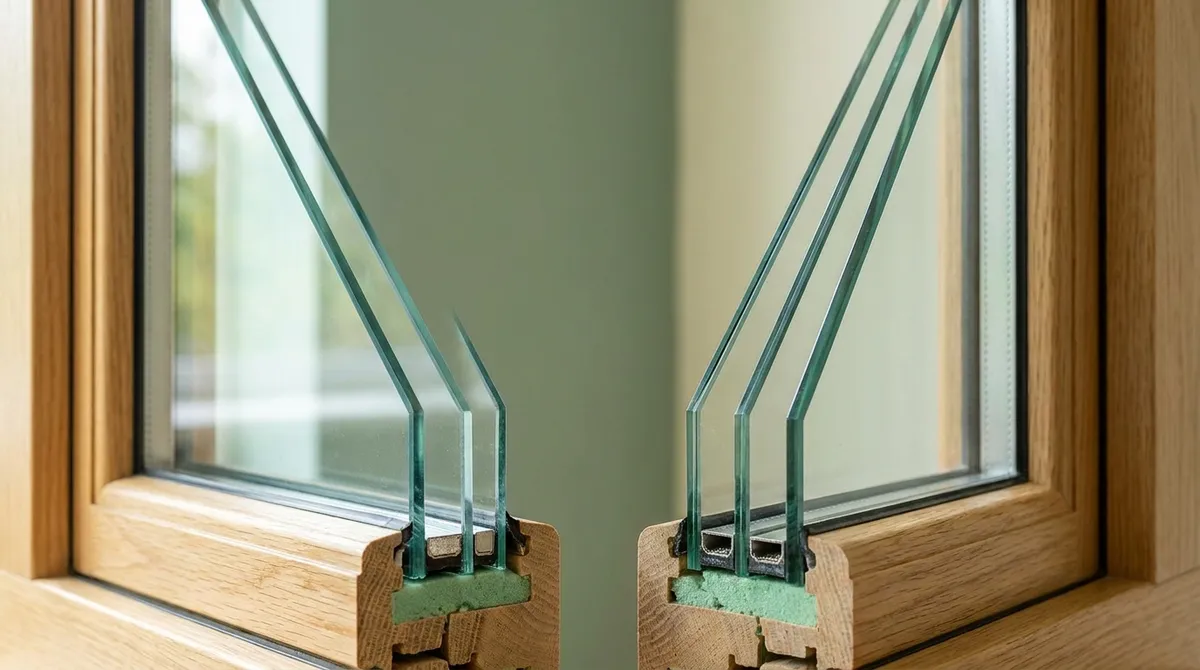
With equal profile performance, it is often the glazing that decides the real comfort of your windows — and that is also where the trick question of the quote hides: should you move up to triple glazing? The honest answer is neither “always” nor “never”. Triple insulates better, but it costs more and weighs more, and that extra cost only pays off in certain situations. This guide helps you decide without being oversold.
Double and triple: what really sets them apart
Double glazing is two panes of glass separated by a layer of insulating gas (usually argon). Triple glazing adds a third pane, so two gas layers. More layers, more barriers against the cold: the logic is intuitive. But the gap can be measured, and it is worth looking at the figures before signing.
The key indicator is the Ug (thermal transmittance coefficient of the glazing alone, in W/m²K): the lower it is, the better the glazing insulates.
Ug ≤ 1.1 W/m²K. Two panes, one argon layer, low-emissivity coating. The right choice in the vast majority of renovations.
Triple glazing The performanceUg ≈ 0.6 W/m²K. Three panes, two gas layers. Relevant in low-energy builds, north façades or rooms exposed to the cold.
Acoustic A different goalAsymmetric panes, high Rw index. Targets noise, not cold: an acoustic double can beat a standard triple.
On the thermal criterion alone, triple wins: going from a Ug of 1.1 to 0.6 clearly reduces losses through the glass. But that gain only tells part of the story — it still has to translate into felt comfort and real savings.
High-performance double glazing: the standard that is often enough
High-performance double glazing today equips the vast majority of windows installed in Belgium, and that is not a flaw. With a Ug around 1.1 W/m²K, it offers excellent thermal comfort, removes the cold-wall sensation and qualifies for regional grants when correctly installed.
Why it covers most needs
- Very satisfactory thermal comfort for a classic renovation that is otherwise correctly insulated
- Moderate weight: it spares the profiles, the hardware and the lifespan of the opening sashes
- The best performance/price ratio, grants included
To understand how this glazing adds to the profile to give the window’s overall performance — the famous Uw — the detail deserves a guide of its own.
Ug (glazing), Uf (profile) and Uw (complete window): knowing what each value covers avoids comparing two quotes that are not saying the same thing.
Decode the quote's values →Triple glazing: when the extra cost is justified
Triple glazing drops towards a Ug of about 0.6 W/m²K — nearly half the losses of high-performance double, on the glazing alone. It is a real leap, but one that does not pay off in every configuration. Triple comes into its own in four situations.
The situations where it earns its price
- A low-energy or passive house. When the whole envelope is very well insulated, the glazing becomes the weak link: triple is then consistent, even required by the targeted standard.
- A north façade or rooms exposed to the cold. Little solar gain, plenty of loss: this is where triple buys the most comfort per euro invested.
- Very large glazed surfaces. On a big bay, the glazing’s share of heat loss is such that the extra cost is more easily justified.
- A deliberate goal of maximum comfort. If you are aiming for the absolute “zero cold wall” and the budget allows it, triple delivers it.
Conversely, on a well-exposed south façade, triple can even slightly reduce free solar gains — a detail that runs against intuition, but that counts on the annual heating bill.
“Triple glazing is not “better” in the absolute: it is better where there is a lot of cold to stop and little sun to let in. Elsewhere, you are paying for a performance you do not feel.
The real extra cost, no detours
Let’s talk figures. At equivalent surface and profile, triple glazing generally represents 15 to 25 % more than high-performance double. That delta covers the extra pane, the additional gas filling and, often, a reinforced profile and hardware to bear the weight.
This is the average extra cost of triple glazing versus high-performance double, at equivalent window. On a full project, the gap runs to hundreds of euros per sash — hence the value of targeting triple rather than generalising it.
This extra cost pays for itself through heating savings… but slowly, and all the more slowly when the rest of the house is already well insulated or the window faces the sun. That is why the most rational trade-off is often mixed: triple on north façades and cold rooms, high-performance double elsewhere.
2026 ranges by material and size, the glazing’s impact on the bill and grants in Wallonia, Brussels and Flanders — to budget double and triple with full knowledge of the facts.
See the price & grants guide →Acoustics: don’t confuse cold with noise
This is the most widespread mistake. People think that by adding a layer of glass they insulate better against noise. Wrong. Sound insulation is measured by the Rw index, expressed in decibels (dB), and it depends on the thickness and above all the asymmetry of the panes — two sheets of glass of different thicknesses break sound waves better than three identical sheets.
The result: an asymmetric acoustic double glazing (for example a laminated pane on the street side) often blocks noise better than a standard triple glazing, at a lower price. If your problem is a busy road, the tram or a nearby school, what you need is not thermal triple but glazing designed for acoustics.
The right reflex by type of nuisance
- I feel cold near the window → this is a matter of Ug / thermal (high-performance double, or triple if north façade or low-energy).
- I hear the street → this is a matter of Rw / acoustic (asymmetric laminated glazing, regardless of the number of layers).
- Both → glazing exists that combines the two goals; it is quoted case by case according to the room’s exposure.
Specifying which of these nuisances you want to fix completely changes the recommendation — and saves you from paying for thermal triple to solve a noise problem it will not resolve.
Weight, a real technical criterion
Triple glazing weighs about 50 % more than double. This is not trivial: heavier glazing puts more strain on the hardware, the hinges and the profile, especially on large opening sashes. An undersized frame ends up fatiguing, closing poorly or sagging.
The good news: on a modern profile, PVC or aluminium, correctly sized and installed by a professional, the weight of triple is handled without difficulty. That is precisely the role of the on-site survey — to check the consistency between glazing, profile and fittings before signing.
The glazing does half the job; the profile does the other half. Choosing the right material / glazing pairing means avoiding the weak link.
Compare PVC, alu and wood-alu →Our honest advice
At wendows, we will not sell you triple glazing on principle. High-performance double (Ug ≤ 1.1) is the standard, and it is enough in the majority of Belgian renovations. Triple (Ug ≈ 0.6) has its place — on north façades, cold rooms, large bays and low-energy projects — but generalising it to the whole house most often amounts to paying for a performance you do not feel on the south side.
And if your real issue is noise, it is acoustic glazing you should aim for, not thermal triple. The only way to decide correctly is an on-site survey that looks at each window, its orientation and your real goal.
The 30-second recap
- High-performance double (Ug ≤ 1.1) — the standard, enough in most renovations.
- Triple (Ug ≈ 0.6) — justified in low-energy, north façade, cold room or large bay.
- Triple costs 15 to 25 % more: target it, do not generalise it.
- Acoustic ≠ thermal: against noise, it is the Rw index (dB) and asymmetric glass that count.
- Triple weighs ~50 % more: an on-site survey checks the profile and fittings before quoting.
Guide verified in May 2026 · updated every year