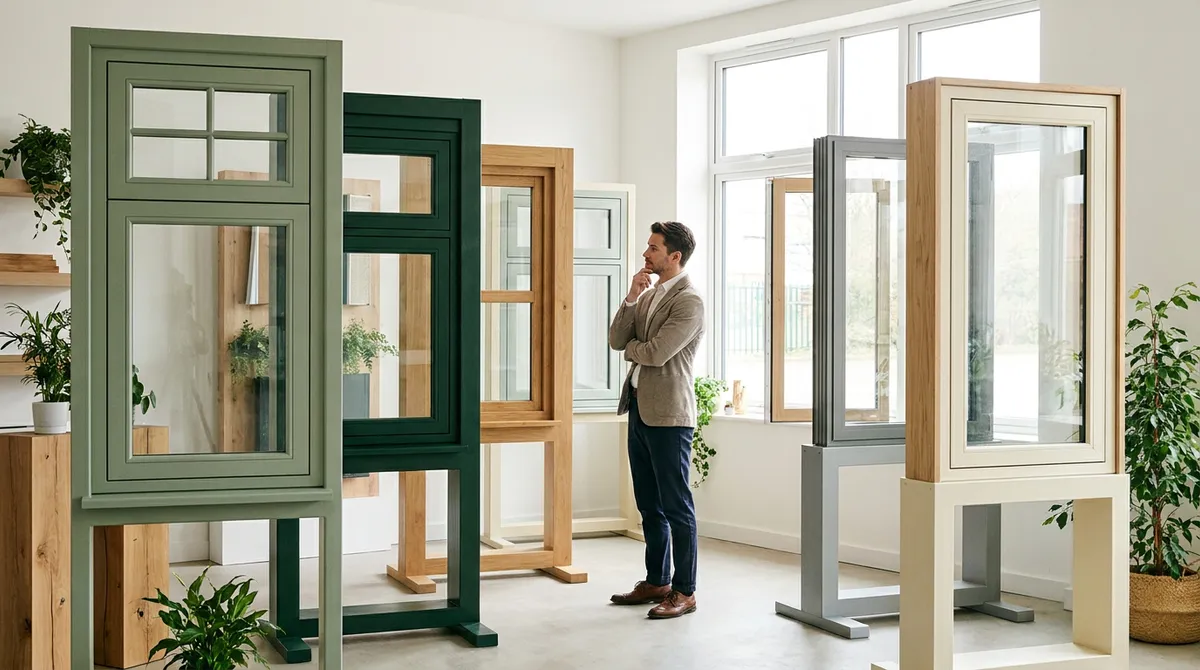
Replacing your window frames is a succession of small decisions that, taken at random, end up getting tangled. Should you start with the material? With the colour? With the glazing? The good news is that there is a logical order — and that once you follow it, each choice sheds light on the next. Here is the seven-step method we apply to every window frame project, to decide without forgetting anything and without paying for what you do not need.
Step 1 — Rank your priorities above all
This is the step everyone skips, and it is the most decisive. Before looking at a single frame, ask yourself one question: what matters most to you? Four criteria always come back, and you have to rank them in order, not want them all to the maximum.
- Budget — the available envelope, grant deducted, sets the frame for everything else.
- Insulation — thermal comfort, heating bills, sometimes acoustics if you border a busy road.
- Aesthetics — the slenderness of the frames, the shade, harmony with the façade and the neighbourhood.
- Maintenance — peace of mind over time, which clearly separates the materials.
Note your ranking on a corner of paper. If budget comes first, you will already know which way to lean; if it is aesthetics, you will accept paying for the slenderness of aluminium. This course, once set, defuses 90% of the hesitations that follow.
Budget, insulation, aesthetics, maintenance: these are the four trade-offs that structure any window frame choice. Ranking them in order saves you endless back-and-forth.
Step 2 — Choose the material
Once your priorities are set, the material almost follows of its own accord. Three families cover nearly all Belgian residential projects: each aims for airtightness, security and insulation, but with different trade-offs.
Very good insulation, contained price, almost no maintenance. The go-to for a controlled-budget renovation.
Aluminium The slimmestNarrow frames, large glazed bays, contemporary line and remarkable longevity.
Wood The warmestNoble appearance and natural insulation, for a home with character — at the price of regular maintenance.
As a budget benchmark, count on 450 to 1,100 € per installed window in PVC, 750 to 1,800 € in aluminium and 1,100 to 2,000 € in wood. PVC offers the best insulation/price ratio, aluminium the slenderness for large glazed surfaces, wood the character of an old home. If your number one priority was budget, PVC almost always wins out; if it was contemporary aesthetics, aluminium is justified.
Insulation, price, maintenance and style material by material, with the strengths and limits of each to decide according to your home.
Compare the materials in detail →Step 3 — Settle the glazing
The frame material does half the work; the glazing does the other. This is the classic mistake: over-investing in a top-of-the-range frame and saving on the glass, when it is the glass that drives most of the insulation.
High-performance double glazing is the standard today: aim for a coefficient of Ug ≤ 1.1 W/m²K, which is also the threshold that generally qualifies for grants. Triple glazing is justified on a north-facing wall, near a noisy road or for a low-energy objective — but it costs more, makes the opening sash heavier and does not always bring a felt gain on a well-lit south orientation.
“A premium window frame with mediocre glazing is like a fine car with bad tyres: everything else is pointless.
Understand the Ug values, the comfort really gained and the extra cost, to match the glazing to the right material.
Choose the right glazing →Step 4 — Define the type of opening, room by room
We rarely think about it in time, and yet it is what makes everyday comfort. The type of opening is decided room by room, according to use and clearance:
- Tilt-and-turn — the versatile standard: full opening to air out, a top-hinged tilt to ventilate without opening everything. Ideal for bedrooms and the living room.
- Sliding or pocket sliding — for a large bay on the garden side, with no swing that eats into the interior space.
- Side-hung casement — the classic inward opening, simple and economical, perfect for small windows.
- Fixed — cheaper, to be reserved for upper sections or clerestories that are never opened.
Each type has a different cost: a large slider weighs more heavily on the quote than a standard tilt-and-turn. Deciding the opening now avoids unpleasant surprises at the pricing stage.
Step 5 — Settle the colour and the finishes
The shade is chosen after the technical points, not before — otherwise you lock yourself into a crush that constrains the budget. White remains the most economical and the most durable over time. Foil-coated shades (anthracite grey, black, wood imitation) are superb but charged as an extra, and on a south-facing façade, a very dark colour in PVC requires a reinforced frame to avoid distortion.
Think of the colour on the street side and the garden side: many frames allow a dark exterior shade and a white interior, to combine façade style with the brightness of the rooms. Also check the consistency of the division (glazing bars, transom) with the rest of the home — that is what distinguishes a successful job from a mismatched assembly.
Step 6 — Check your grants before signing
This is the step that changes the real budget, and it is checked before signing, not after. The regions support window frame replacement provided the glazing is high-performing: in Wallonia, the support starts from 40 €/m² of glazing replaced, subject to a Ug coefficient condition and according to your income. Brussels and Flanders have their own schemes.
The golden rule: the grant is conditional on the glazing performance, and the Ug value must appear in black and white on the quote and the invoice. A serious installer tells you straight away which support your project qualifies for and puts the file together with you.
Amounts, conditions and steps region by region — and how the grant is deducted from the installed price.
See the window frame grants →Step 7 — Read the quote like a pro
The last step, and the most rewarding: a well-read quote means a project with no unpleasant surprise. To compare two offers on equal terms, check that each details the same items:
- the material and the frame range (entry, mid or top of the range);
- the Ug value of the glazing, written explicitly;
- the type of opening room by room, in line with step 4;
- for aluminium, the mention of a thermal break (without it, insulation drops off);
- the removal of the old window frame and its disposal;
- the installation, the interior finishes (sills, pointing) and the warranty.
A quote that passes over these items in silence is not comparable — and often hides an item that will reappear during the job. To place the quoted amounts, keep in mind the ranges by material and compare them with the price guide.
2026 ranges by material and dimension, factors that make the bill vary and an example of a worked quote, grants included.
See the price & grants guide →How long do your window frames last?
One last benchmark to put the effort of this method in perspective: a quality window frame lasts around 25 years. The choice you make today will therefore stay with you for a long time — all the more reason to take it step by step rather than in the rush of a crush or a hurried quote.
This is the average lifespan of a quality window frame. Seven steps for a choice that is lived for a quarter of a century: the time spent deciding well is quickly paid back.
And nothing forces you to make everything uniform: it is common to install aluminium on a large bay on the garden side and PVC on the bedroom windows, to combine style and budget on the same job.
The method in 30 seconds
- 1. Priorities — rank budget, insulation, aesthetics and maintenance in order.
- 2. Material — PVC, aluminium or wood follows from your priorities (450 to 2,000 €/installed window).
- 3. Glazing — aim for double glazing Ug ≤ 1.1; triple only if useful.
- 4. Opening — tilt-and-turn, sliding or fixed, room by room.
- 5. Colour — after the technical points; beware of dark shades facing full south.
- 6. Grants — checked before signing (Wallonia from 40 €/m²).
- 7. Quote — compare Ug, openings, removal, installation and finishes item by item.
Guide verified in May 2026 · updated every year