« Devis clair, sans surprise, primes comprises. Un seul interlocuteur du début à la fin. Je recommande sans hésiter pour le photovoltaïque. »
Pierre M.Tournai
Fitting out the roof of an apartment building calls for a different approach than a house: approval of the general meeting, coordination with the managing agent, the split between co-owners and the choice between powering the common areas or collective self-consumption. We guide you from the study to the AGM vote, then to installation.
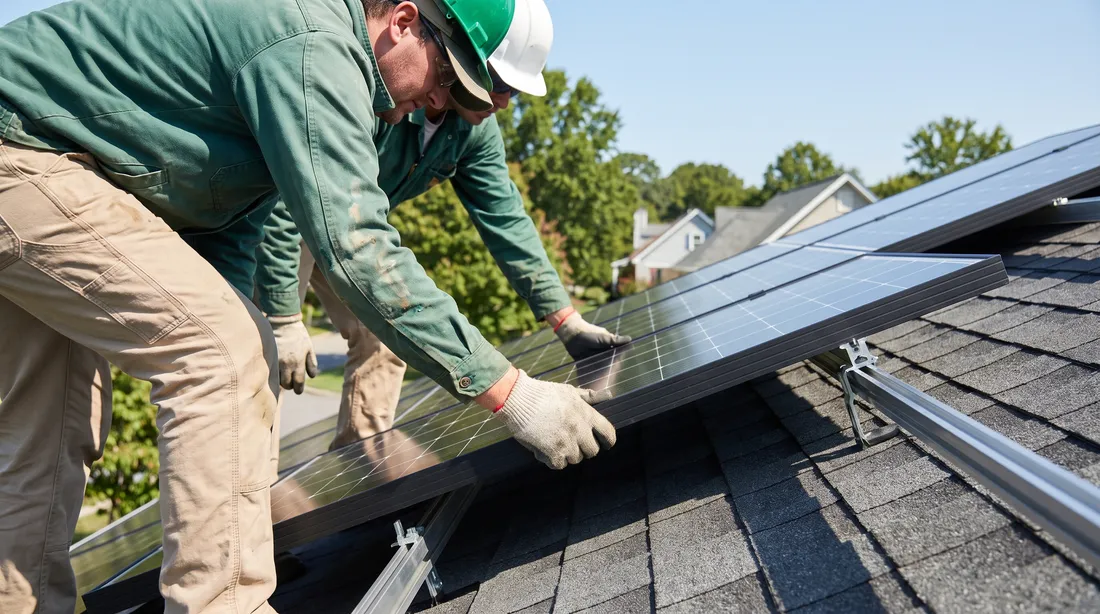
A building’s roof is generally a common area: any installation requires a collective decision. Our role is to make the project clear for the general meeting and fair for every co-owner.
Installation on the common roof is voted at the general meeting. We provide the managing agent with a complete file — study, quote, financing and distribution plan — to put the item on the agenda and ease the vote.
The simplest option: production covers the lift, stairwell lighting, ventilation and the shared boiler room. The savings directly reduce the charges shared among all co-owners.
More ambitious: the electricity produced is shared between the apartments according to an agreed distribution key. Each participating household self-consumes a share and lightens its bill, while the surplus remains valued.
Visit to the building: roof surface and condition, orientation, load-bearing structure, access and meter locations. We confirm technical feasibility before going to the AGM.
We prepare the file to present at the general meeting: costed quote, estimated output, common-area or collective self-consumption scenario, distribution key and financing plan.
Once the decision is adopted, we handle the procedures: declaration to the network operator, agreements between participating co-owners and formalities tied to collective self-consumption.
Installation by a RESCert-certified team, connection to standards and commissioning. Monitoring lets the managing agent and co-owners follow production and savings.
Two logics coexist in a building. Powering the common areas is simple to vote and to manage: production reduces the common charges for everyone. Collective self-consumption shares the electricity with the participating private apartments, via a distribution key and the coordinating role of the managing agent.
A free study answers the essentials before going to the AGM: usable surface, estimated output, distribution scenario and budget, with no obligation.
Since the roof is a common area, the decision rests with the general meeting of co-owners. The project must be put on the agenda by the managing agent and submitted to a vote according to the majority rules set by co-ownership law. We provide the managing agent with a ready-to-present file to ease that vote.
The managing agent is the central contact: they put the item on the AGM agenda, pass the file to the co-owners, carry out the decision voted and then coordinate the management of the installation and the distribution of savings or production. We work in direct contact with them at every step.
It all depends on the chosen scenario. If production powers the common areas, the savings flow into the common charges according to the usual ownership shares. In collective self-consumption, electricity is shared between participating apartments according to a distribution key agreed and formalised between them.
It’s the sharing of the electricity produced on the roof between several occupants of the same building. Each participating apartment self-consumes a share of the output according to a defined key, which lightens its bill, while the surplus remains valued. It requires an agreement between participants and procedures with the network operator, which we take care of.
This is common and does not block the project. The installation can be limited to the common areas, which benefit the whole building, or collective self-consumption can be reserved for the willing co-owners only. The distribution key and the financing are then set on the actual participants.
5.0/5 · 1verified reviews
« Devis clair, sans surprise, primes comprises. Un seul interlocuteur du début à la fin. Je recommande sans hésiter pour le photovoltaïque. »
Tell us the type of building, the number of apartments and the scenario you’re considering: we’ll propose a free study, a file ready for the AGM and a clear quote, with no obligation.