
« Châssis, panneaux et pompe à chaleur en une seule fois : on a eu un seul devis, un seul planning et zéro paperasse pour les primes. Le résultat est impeccable et notre facture d'énergie a chuté. On ne pensait pas que ce serait aussi simple. »
Sizing a pool heat pump: the right kW output for your water volume
An undersized heat pump will never bring the water to 28°C; oversized, it costs a fortune for nothing. The right calculation cross-references the pool volume, the target temperature, the Belgian climate and, above all, whether there is a cover. Here is the method, no guesswork.
- ~1 kW / 8 m³
- benchmark with a cover
- COP 5–6
- in mild summer air
- −50%
- demand with a cover
What determines a pool heat pump’s output
Sizing is not reading a label: it is cross-referencing six concrete parameters. Here are the ones that tip the calculation, with Belgian benchmarks to back them up.
- Pool volume in m³
This is the basis of the calculation: length × width × average depth. An 8 × 4 at 1.5 m is ~48 m³. The bigger the volume, the more output is needed to raise and hold the temperature, proportionally.
- Target temperature 27–28°C
Every degree gained costs energy. Aiming for 28°C rather than 26°C noticeably raises demand. We set the target first, because the whole sizing follows from it — the gap with air temperature drives the losses.
- Night-time losses the key factor
In Belgium, nights from May to September often drop below 12°C. Water loses most of its heat at night through evaporation and convection. It is this factor, more than daytime heating, that sizes the pump.
- Cover / enclosure / roller ÷ 2
A bubble cover halves evaporation losses, sometimes more. It is the element that changes the whole calculation under our climate: without a cover, far more output is needed; with one, you size as tightly as possible.
- Filtration flow rate compatible
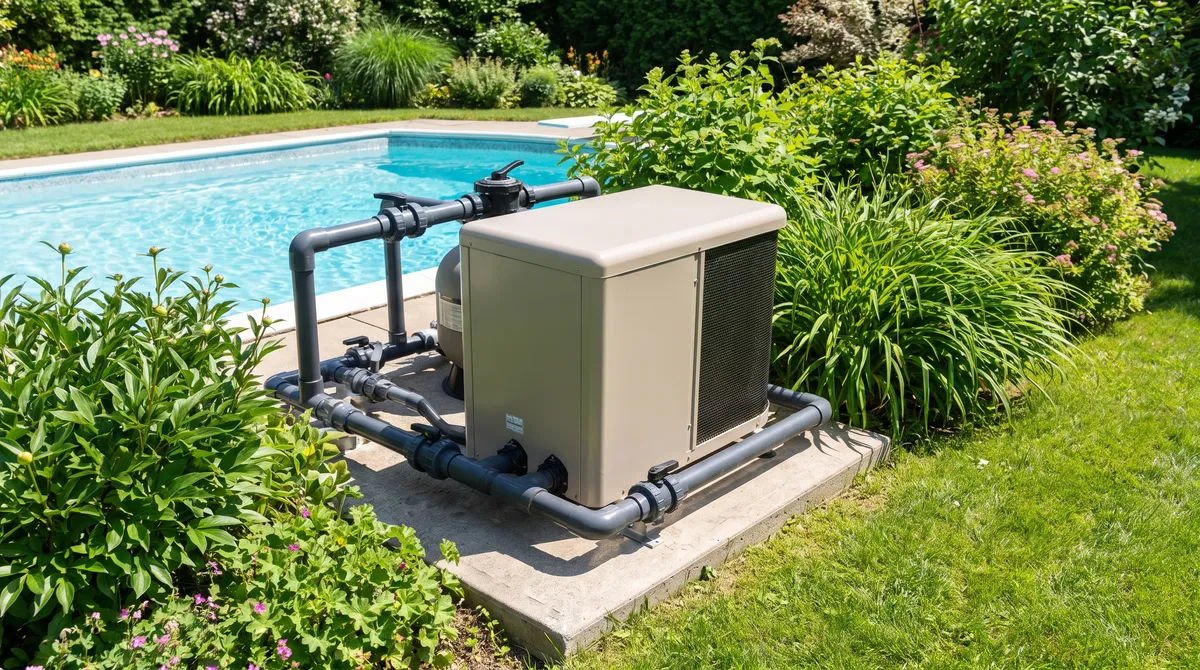
The pump mounts on the filtration circuit: its nominal flow (m³/h) must be covered by the filtration pump. An insufficient flow makes the heat exchanger cut out. We check compatibility before settling the model.
- Location & season May–Sept.
The useful season in Belgium runs from May to September, with air often around 15–22°C. A longer season or a cooler region (the Ardennes) pushes the output up to make up for less helpful air.
* Indicative benchmarks for an outdoor in-ground pool under the Belgian climate. The exact sizing depends on your pool, the cover and the exposure — calculated during the survey.
Sizing it right: what you gain, what you avoid
Careful sizing means water at the right temperature without an outrageous bill. Here is what a sound calculation delivers — and the pitfalls of a poor choice.
The benefits of a sound calculation
- Fast warm-upWell-matched output heats the pool in a few days at the start of the season.
- Temperature held overnightThe pump offsets night-time losses and the water is still 28°C in the morning.
- Optimised COPA suitable model runs in its ideal range: more efficiency, less electricity.
- Controlled investmentYou do not pay for useless excess output or an electric backup.
The pitfalls to avoid
- UndersizingThe pump runs non-stop without ever reaching the target: wear and disappointment.
- Forgetting the coverCalculating without a cover nearly doubles the demand — and the bill that follows.
- Ignoring the variable COPThe COP drops as the air cools: a pump cut too fine collapses on a cool night.
- Unsuitable filtration flowA filtration pump that is too weak makes the exchanger cut out, whatever the output.
What sizing for which case?
The method is the same, but the result changes a lot depending on your installation. Three cases common in Belgium:
-
Pool with a cover
The ideal case: with a bubble cover deployed every night, you size as tightly as possible, often ~1 kW for 8 m³. Comfort without overconsumption.
-
Pool with no cover
Without a cover, night-time losses soar. Output must be raised sharply — or you accept water that does not hold overnight. A cover remains strongly advised.
-
Extended season / warm water
Aiming for 29°C or swimming from April to October calls for higher output to offset cooler air. We size slightly up for flexibility.
Choosing the output step just above lets you warm the water faster at the start of the season and keep some margin on a cool night. Discover the pool heat pump range, or the compact version for an above-ground pool.


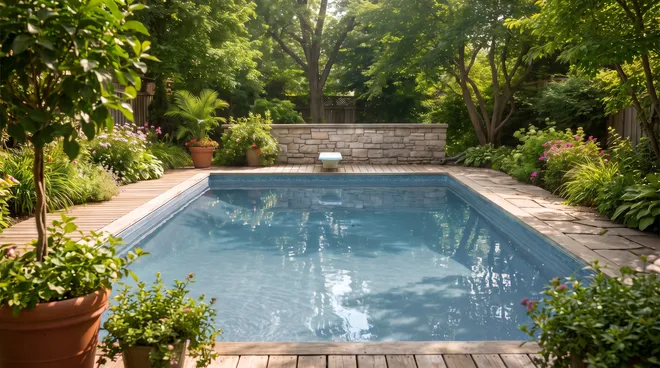
An 8 × 4 in-ground pool heated to 28°C all summer thanks to the right calculation
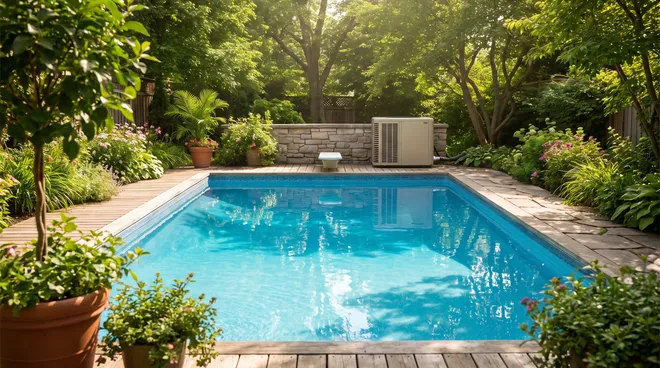
The client complained of water that was never warm enough. The 48 m³ pool had a pump that was too small, with no cover. We recalculated the demand, fitted a pump of suitable output and added a bubble cover: the water now rises to 28°C in three days and holds there despite the cool nights.
- 28°Cwater held day and night
- 3 daysto warm up
- −50%losses with a cover
They chose wendows
5.0/5 · 3verified reviews
« Passage du mazout à une pompe à chaleur air-eau. Chantier propre, anciens radiateurs conservés. La maison est mieux chauffée pour bien moins cher. »
« PAC air-air réversible installée avant l'été. Confort été comme hiver, et le SAV répond vite. Très satisfait du suivi. »
Sizing, choosing the range, or above-ground?
This page is a pure calculation guide. Once the output is known, open the range suited to your pool — in-ground or above-ground — to choose the model.
| Critère | SizingVous êtes ici | Pool heat pump (range)Voir la gamme → | Above-ground pool heat pumpVoir la gamme → |
|---|---|---|---|
| Purpose of the page | kW calculation method | Models & range | Compact models |
| Type of pool | All pools | Mainly in-ground | Above-ground / tubular |
| Output benchmark | ~1 kW / 8 m³ | Depends on model | 3–7 kW |
| Role of the cover | Detailed (÷ 2) | Recommended | Essential |
| Indicative COP | Explains the variable COP | COP 5–6 | COP 4–5 |
| Budget | Helps you frame it | €€ — depending on kW | € — more affordable |
| Ideal for | Calculating before buying | Fixed pool | Small demountable pool |
- the range
Pool heat pump
Once the output is calculated, choose the model suited to your in-ground pool: flow, sound level, COP.
See the pool heat pump range → - compact
Above-ground pool heat pump
For tubular and demountable pools: compact, more affordable heat pumps, easy to connect.
Discover above-ground → - to combine
Solar panels
A pool heat pump runs in broad daylight, in summer: paired with solar, it heats the water almost for free.
See solar panels → - understand
Heat pump types
Air-to-water, air-to-air, pool, geothermal: understand the heat pump families before sizing yours.
Compare heat pump types → - bespoke
Free sizing
Give us your pool’s volume and use: we calculate the ideal output and the suitable model.
Request my calculation → - ↑ category
All heat pumps
An overview of our heat pumps in Belgium: home heating, hot water and pool, grants and installation.
Back to the heat pump guide →
What does a well-sized pool heat pump cost?
The price follows the output, hence the pool volume. Better to invest in the right calculation than in useless excess output. Here are benchmarks for an installed pool heat pump.
See the pool heat pump range and prices →* Indicative ranges for an installed pool heat pump, depending on output and connection. Precise costing during your free quote.
- Pool heat pump 5–8 kW from €1,200small pools, installed
- Pool heat pump 10–14 kW from €2,200medium pools, installed
- Bubble cover from €150halves the losses
- Reduced VAT 6%in renovation (home > 10 years)
Your questions on output calculation
What heat pump output for my pool volume? +
As a rule of thumb under the Belgian climate, count on roughly 1 kW per 8 m³ of water if the pool has a cover, and noticeably more without one. For a covered 48 m³, a pump of around 6 to 8 kW fits. That is a benchmark: the exact calculation cross-references the target temperature, the air and the season.
Why does the cover change the calculation so much? +
Most of a pool’s heat loss happens through surface evaporation, especially at night. A bubble cover halves those losses, sometimes more. In Belgium, where nights stay cool even in summer, it is the element that lets you size the pump as tightly as possible — and hold the temperature.
Should a pool heat pump be oversized? +
A slight oversizing is advisable: it warms the water faster at the start of the season and keeps some margin on a cool night, when the COP drops. There is no point going too far, though: excessive output costs more to buy with no real benefit.
Is the stated COP always real? +
No. A pool heat pump’s COP is measured at a given air temperature (often 26°C). It drops as the air cools: on a Belgian night at 12°C, the real efficiency is lower. That is why we size with some margin and look at the COP at several temperatures, not just the maximum figure.
Is my filtration pump enough for the heat pump? +
The heat pump mounts on the filtration circuit and needs a minimum flow (in m³/h) to work. If the filtration pump is too weak, the exchanger cuts out and the pump goes into safety mode. We always check the flow compatibility before settling the model.
What is the heating season in Belgium? +
The useful season generally runs from May to September, with air around 15 to 22°C. Nights stay cool, which weighs on the losses. Wanting to swim from April or until October, or in a cooler region like the Ardennes, calls for higher output to offset less helpful air.
Get the sizing of your pool heat pump within 48h
Give us the volume, the target temperature and whether there is a cover: we calculate the ideal output and the suitable model. No commitment.
- Free output calculation
- Cover and flow taken into account
- Installation by our certified fitters