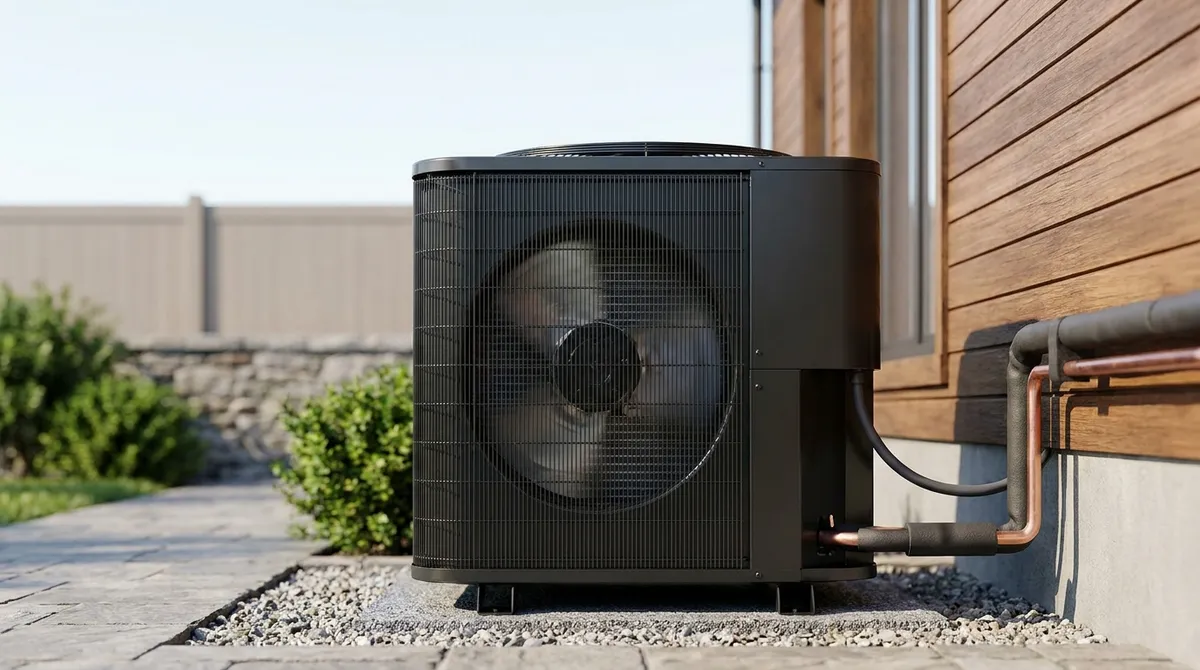
A heat pump intrigues because it seems to defy common sense: how can a device plugged into a simple socket deliver three to five times more heat than the electricity it consumes? The answer lies in a physical principle two centuries old — thermodynamics — and in an ingenious cycle that never creates heat, but simply moves it. This guide lifts the hood and details the mechanism, step by step. If you’re looking for a general explanation first, start instead with the overview of how it works; here, we go into the technical detail.
The starting idea: move heat, not make it
A conventional electric radiator turns electricity into heat: 1 kWh consumed gives at best 1 kWh of heat. A heat pump works on a completely different principle. It behaves like a pump, in the literal sense: it takes heat already present in the environment — outside air, the ground or a water table — and transfers it inside your home.
The key thing to remember is that there is heat available everywhere around us, even when it’s cold. Temperature only reaches its true “zero” at −273 °C (absolute zero): outside air at 0 °C, or even −5 °C, therefore still contains a considerable amount of thermal energy. The challenge is not to find this heat, but to lift it from a cold medium to a warmer one — something that never happens spontaneously. That is the whole role of the refrigeration cycle.
The heart of the system: the refrigerant
To transport heat, the heat pump circulates a refrigerant in a closed loop. This fluid has a precious property: it changes state — from liquid to gas and back — at low, perfectly controlled temperatures, where water, by contrast, boils at 100 °C.
These changes of state are the engine of the whole system:
- When the fluid evaporates (goes from liquid to gas), it absorbs heat from its environment.
- When it condenses (goes from gas to liquid), it releases that heat.
It is exactly the phenomenon that cools your skin when a little alcohol evaporates on it: evaporation draws in heat. The heat pump exploits this principle in a loop, controlling where the fluid evaporates (outside, to capture) and where it condenses (inside, to deliver).
The refrigeration cycle in four stages
The whole operation rests on a closed circuit run through by four components, in this order: evaporator → compressor → condenser → expansion valve, then back to the evaporator. Let’s follow a drop of fluid throughout its loop.
1. The evaporator: capturing heat outside
The fluid arrives here in liquid form, at very low pressure and at a very cold temperature — typically −20 to −40 °C, so colder than the outside air, even in winter. By simple temperature difference, the air (or the ground) gives up its calories to the fluid, which absorbs them and evaporates. It leaves the evaporator as a low-pressure, lukewarm vapour. The heat from the environment has entered the circuit.
2. The compressor: raising the temperature
This is the central stage, and the only place where electricity is spent. The compressor draws in this lukewarm vapour and compresses it strongly. Now compressing a gas means concentrating its energy in a reduced volume: its pressure rises, and its temperature with it. This is exactly what heats the body of a bicycle pump when you inflate a tyre.
At the compressor’s outlet, the fluid has become a very hot vapour under high pressure — hot enough (often 60 to 80 °C) to heat the water of your heating circuit. The compression did not create heat from nothing: it concentrated a diffuse heat, captured outside, to bring it to a useful temperature level.
Compression does not “make” heat: it squeezes into a small volume the energy that the fluid captured outside. The more the pressure rises, the more this energy concentrates — and the higher the temperature climbs. The compressor is the only part of the cycle that consumes electricity.
3. The condenser: delivering heat inside
The hot high-pressure vapour passes through the condenser, an exchanger in contact with the home’s heating circuit (radiator water, underfloor heating or air, depending on the type of heat pump). By giving up its heat to this colder circuit, the fluid condenses: it returns to the liquid state. It is at this precise moment that your home receives its heat. The fluid leaves liquid, still under high pressure, but markedly cooled.
4. The expansion valve: returning to the start
It remains to bring the fluid back to its starting state to close the cycle. The expansion valve (or thermostatic expansion valve) makes the liquid’s pressure drop sharply. This expansion is accompanied by a sharp fall in temperature: the fluid becomes once again that very cold, low-pressure liquid ready to set off again into the evaporator. The loop is closed, and the cycle starts over continuously.
This is the ratio between the heat delivered and the electricity consumed by a modern heat pump. For 1 kWh paid at the meter, you recover 3 to 5 kWh of heat — the rest being drawn for free from the environment.
A reverse Carnot cycle
This four-stage circuit has a learned name: it is an application of the reverse Carnot cycle. In the 19th century, the engineer Sadi Carnot described how an ideal heat engine converts heat into mechanical work (the principle of the engine). The heat pump does the opposite: it spends mechanical work — supplied by the compressor — to lift heat from a cold source to a hot source.
Without this input of work, heat would spontaneously go from hot to cold, never the reverse: this is the second law of thermodynamics. The heat pump does not violate this law, it gets around it by paying the energy “toll” of the compressor. And the smaller the temperature gap between the cold source (outside) and the hot source (your circuit), the lower this toll — which is precisely why a heat pump performs better in mild weather and with low-temperature heating, such as underfloor heating.
Worth noting: it is exactly the cycle of a refrigerator, simply reversed. The fridge extracts heat from its interior to reject it behind it; the heat pump extracts heat from outside to release it inside.
Why the COP always exceeds 1
We can now lift the “mystery” from the start. A heat pump’s efficiency is measured by its COP (coefficient of performance): it is the ratio between the heat delivered and the electricity consumed. A COP of 4 means that for 1 kWh of electricity, the device supplies 4 kWh of heat.
How can an “efficiency” exceed 100%? Quite simply because it is not a conversion efficiency, but a ratio of transport. The electricity is not used to make heat: it powers the compressor that moves heat already present in the air or the ground. The 3 extra kWh don’t come from nowhere — they come from the environment, captured for free at the evaporator. The principle of conservation of energy is fully respected: nothing is created, it’s relocated.
Displayed COP, seasonal SCOP, real efficiency over a full year: our dedicated guide explains how to read and compare a heat pump’s performance.
Understand COP and SCOP →What the principle means in everyday life
Understanding the mechanism sheds light on very concrete choices. Since performance depends on the temperature gap to be bridged:
- A low water supply temperature (underfloor heating, low-temperature radiators) reduces the compressor’s effort and pushes up the COP.
- Good insulation lowers the needs, and therefore the demand on the heat pump.
- The climate matters: at our Belgian latitudes, the air keeps enough calories all year round for an air-to-water heat pump to stay efficient, with a backup for the harshest cold spells.
It is this logic of transfer — and not of combustion — that makes the heat pump one of the most efficient heating systems available today. To discover the models, the budgets and the grants, head to the heat pump page.
- A heat pump does not create heat: it moves it from a cold medium to a hot one.
- The refrigerant transports the heat thanks to its changes of state (liquid ↔ gas).
- The cycle follows four stages: evaporator (captures) → compressor (raises the temperature) → condenser (delivers) → expansion valve (resets).
- It is a reverse Carnot cycle: the compressor pays the “toll” that lifts the heat.
- The COP > 1 because the energy is transported instead of produced — the surplus comes from the environment.
Guide verified in May 2026 · updated every year