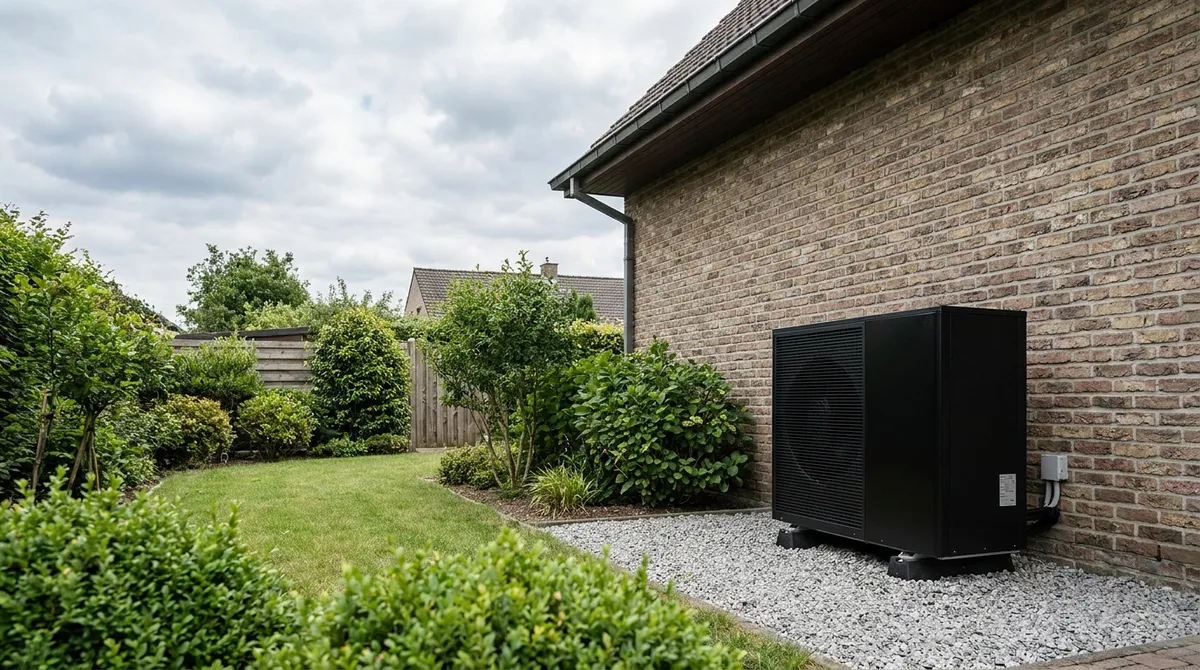
When comparing heat pumps, two acronyms keep coming up on every technical sheet: COP and SCOP. These are the two indicators that sum up the efficiency of a heat pump — in other words, the amount of heat it gives you back for every kilowatt-hour of electricity it consumes. Understanding them properly means making sure you choose a genuinely economical appliance, and not just a nice figure on a brochure.
What exactly is the COP?
The COP, or Coefficient of Performance, is the ratio between the heat produced and the electricity consumed to produce it. It is a simple division:
COP = heat produced (kWh) ÷ electricity consumed (kWh)
One example speaks for itself. A heat pump showing a COP of 4 returns 4 kWh of heat for 1 kWh of electricity consumed. The 3 kWh of difference do not come from nowhere: the heat pump draws them for free from the outside air (or the ground, depending on the model) and simply uses the electricity to run the compressor that concentrates them.
This is what makes the heat pump so efficient compared with conventional heating. A gas boiler or an electric resistance will never exceed an efficiency of 1: at best they return the energy supplied to them. A heat pump, by contrast, multiplies every kilowatt-hour.
With a COP of 4, your heat pump produces four times more heat than it consumes in electricity. That is three kWh drawn for free from the air for a single kWh paid on your bill.
The SCOP: performance across the whole season
The COP has one shortcoming: it describes performance at a precise moment, under clearly defined test conditions. But a heat pump does not work all year under the same conditions. On a mild autumn day, its COP is excellent; on an icy January morning, it drops. Relying on the nominal COP alone therefore gives an incomplete picture.
This is precisely why the SCOP exists, the Seasonal Coefficient of Performance — the seasonal COP. It averages the performance of the heat pump over an entire heating season, weighting the mild and cold temperatures as they actually occur over the course of winter.
The SCOP is therefore the most realistic figure for estimating what the heat pump will really cost you. It is the one to look at first when comparing two models, well before the COP printed in large type on the sales sheet.
What values to aim for?
For a modern air-to-water heat pump intended to heat a house, here are the benchmarks to keep in mind:
- Nominal COP: between 3.5 and 4.5 for a good model.
- SCOP: around 4, which constitutes an excellent benchmark over the year.
- Below 3 in SCOP, the appliance remains economical compared with direct electric heating, but there is probably something better available at comparable size and budget.
These values vary by technology. A geothermal heat pump (which draws from the ground, at a stable temperature) often reaches higher SCOPs than an air-to-water heat pump, which is itself more efficient than an air-to-air system for heating water. Comparing two models therefore only makes sense at equivalent technology and conditions.
What makes the COP rise or fall
The COP is not a constant carved into the appliance: it depends on several factors, some of which are decided at the time of installation and heating design.
The outdoor temperature
This is the most visible factor. The colder it is outside, the greater the gap to bridge between the outside air and the heating water, and the harder the compressor works. The COP therefore logically falls in very cold weather — hence the value of the SCOP, which incorporates these variations.
The water flow temperature
This is the most powerful lever, and the most often overlooked. The milder the heating water, the higher the COP climbs. A heat pump feeding underfloor heating at 35 °C is far more efficient than the same heat pump forced to heat water to 55 °C for old radiators. Every degree gained on the flow temperature translates into a performance gain.
Emitters and insulation
Everything is connected. Low-temperature emitters (underfloor heating, fan coil units, oversized radiators) make it possible to lower the flow temperature, and therefore raise the COP. A well-insulated home, moreover, needs less heat, which eases the burden on the heat pump still further. Real performance is as much a matter of installation as of equipment.
A heat pump that is too powerful multiplies short cycles and loses efficiency; one that is too weak exhausts itself in very cold weather. Correct sizing is the condition for a real COP that lives up to the catalogue.
Read the sizing guide →Nominal COP versus real COP
Here is the classic trap. The nominal COP shown on the sheet is measured in a laboratory, under ideal standardised conditions — often at 7 °C outdoors and with a moderate flow temperature. In your home, reality is harsher: temperatures that plunge, water that sometimes has to rise higher than expected, settings that could be improved.
As a result, the real COP is almost always lower than the nominal COP. This is not deceit, it is the very nature of a laboratory measurement. The good news is that the SCOP fills a large part of this gap, since it is calculated on representative seasonal conditions. To judge a model, therefore, rely on the SCOP rather than the finest COP in the brochure.
The COP and the grant
Performance is not just a matter of your bill: it also determines your grant. Belgian support schemes do indeed impose a minimum efficiency for a heat pump to qualify for financial support. This threshold is generally expressed as a minimum COP of around 3.5 measured under reference conditions, or a floor SCOP depending on the scheme.
A model that is too inefficient may therefore miss out on the grant — a shortfall that often exceeds the small saving made at purchase. The precise thresholds change from one region and one year to the next, which is why we always check, on the technical sheet, that the chosen model is indeed eligible before pricing.
A high COP reduces the heating bill and determines access to grants: two effects that weigh directly on the payback time of your installation.
See the profitability guide →How to compare two heat pumps
Faced with two quotes, the method comes down to four simple reflexes:
- Compare the SCOPs, not the COPs. The SCOP reflects real use over the year; it is the decisive figure.
- Compare on equal terms. A SCOP only makes sense for the same water flow temperature regime (for example 35 °C for underfloor heating). Check that both sheets are indeed talking about the same regime.
- Stay within the same technology. Air-to-water against air-to-water, geothermal against geothermal: comparing an air-to-air with an air-to-water on water heating would make no sense.
- Check eligibility for the grant. A model that is slightly cheaper but below the performance threshold may end up costing you more.
And do not forget that the best equipment, badly installed, always disappoints. The sizing, the flow temperature and the quality of installation count as much as the figure printed on the sheet. That is exactly the purpose of the study we carry out before every heat pump project.
The 30-second recap
- The COP = heat produced ÷ electricity consumed: a COP of 4 is 4 kWh of heat for 1 kWh of electricity.
- The SCOP is the average COP over the heating season — the most realistic figure for comparing.
- Aim for a COP of 3.5 to 4.5 and a SCOP around 4 for an efficient air-to-water unit.
- The water flow temperature is the first lever: milder water = higher COP.
- A COP of around 3.5 is often required to qualify for the grant — to be checked on the technical sheet.
Guide verified in May 2026 · updated every year