« Devis clair, sans surprise, primes comprises. Un seul interlocuteur du début à la fin. Je recommande sans hésiter pour le photovoltaïque. »
Pierre M.Tournai
Sheds, cowsheds, barns: your roofs represent hundreds of unused square metres. We turn them into a photovoltaic plant sized for your farm, with self-consumption matched to your peak usage — milking, drying, ventilation, cold rooms — and a quantified return on investment.
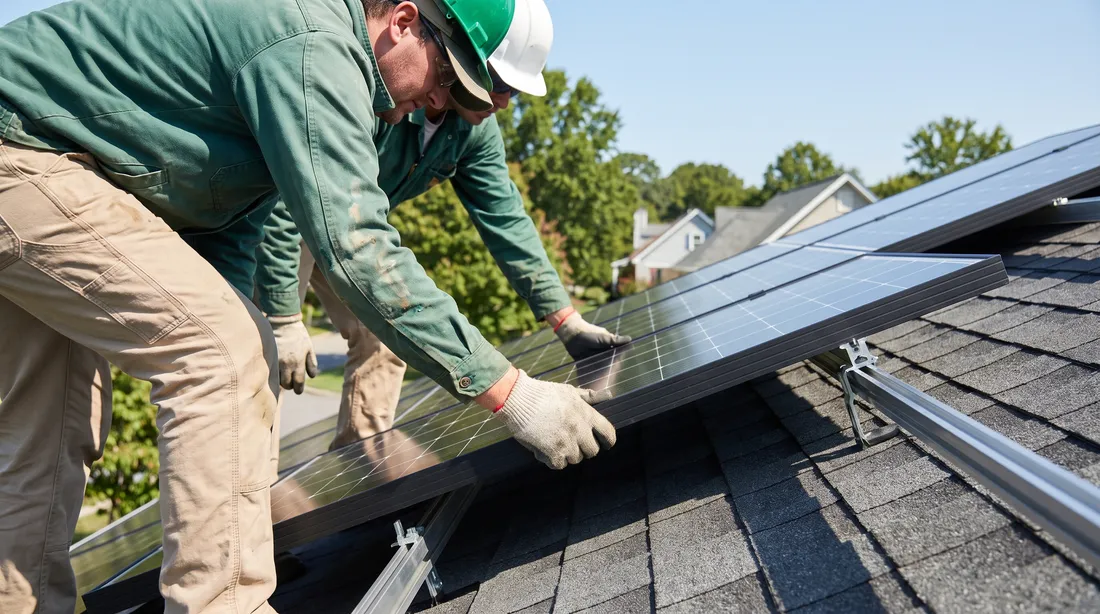
An agricultural building is not a house: large surfaces, varied frameworks, roofs sometimes in fibre-cement, and consumption driven by powerful equipment. Our approach starts from your load curve and the real condition of your roof.
Survey of the surfaces of the shed, cowshed or barn, analysis of the orientation and verification of the framework’s load-bearing capacity. We confirm what the structure can take before any layout work.
From 30 to over 100 kWp depending on your roof and your consumption. We match the power to your energy-hungry processes — milking, drying, ventilation, refrigeration — to maximise self-consumption.
Installation on steel decking, corrugated sheet or after prior asbestos removal. Fixings suited to large agricultural slopes, protected cabling and watertightness preserved across the whole surface.
We measure your buildings’ roofs, check the framework and record your consumption profile (bills, daytime peaks). Asbestos diagnosis if the roofing is fibre-cement.
A costed proposal with the power in kWp, estimated output, return on investment and, if needed, the asbestos-removal item plus a new steel-deck roof built into the project.
Installation of the structures, modules and inverters by a RESCert-certified team. The site is organised to limit disruption to farm activity.
Connection to RGIE standards, declaration to the network operator, support on the prosumer tariff and monitoring setup to track production and self-consumption.
Two logics arise in farming. If your roof is sound, we aim for maximum self-consumption: solar directly powers milking, drying or cold rooms during production hours. If your roofing is fibre-cement, we combine asbestos removal, a new steel-deck roof and photovoltaics in a single project — installing the panels partly finances the re-roofing.
A free roof study is enough to find out: usable surface, load-bearing capacity, possible power and estimated output, with no obligation.
It all depends on the surface and the load-bearing capacity of the roof. A large shed or cowshed commonly takes 30 to over 100 kWp, where a house is limited to 4 or 6 kWp. Our study surveys the usable surface and the framework capacity before setting the power.
Old fibre-cement agricultural roofs often contain asbestos and cannot take panels as they are. We integrate asbestos removal and the installation of a new steel-deck roof into the photovoltaic project: a single site, and the solar plant partly finances the re-roofing.
Yes, and often more than in residential. A farm consumes during the day — milking, drying, ventilation, cold rooms — exactly when the panels are producing. This high self-consumption, combined with the large available surfaces, shortens the return on investment. Our study quantifies your case from your bills.
The surplus you don’t self-consume is injected onto the grid and subject to the prosumer tariff in Wallonia. The goal in farming is to maximise self-consumption to reduce this surplus, by matching production to your energy-hungry processes. We support you on the procedures and the choice of the contract best suited to your farm.
The site is organised to limit the impact: work zones are secured and the schedule takes your constraints into account (milking, harvest, access to equipment). Installation on a large roof proceeds in phases, and the connection is coordinated with the network operator to reduce outages.
5.0/5 · 1verified reviews
« Devis clair, sans surprise, primes comprises. Un seul interlocuteur du début à la fin. Je recommande sans hésiter pour le photovoltaïque. »
Tell us the type of building (shed, cowshed, barn), the condition of the roof and your consumption: we’ll propose a free roof study, high-power sizing and a clear quote, with no obligation.