Your panels produce the most at midday, when you’re often away; you mostly consume in the evening, when they no longer produce. To reconcile these two curves, two solutions share the name “battery” but have almost nothing in common. The physical battery installs genuine storage equipment in your home. The virtual battery is an accounting service managed by your supplier. This guide compares them criterion by criterion to help you choose the one that fits your profile.
Two solutions, two logics
Before comparing the figures, you have to understand that these two options answer opposing philosophies. One bets on material independence, the other on contractual optimisation.
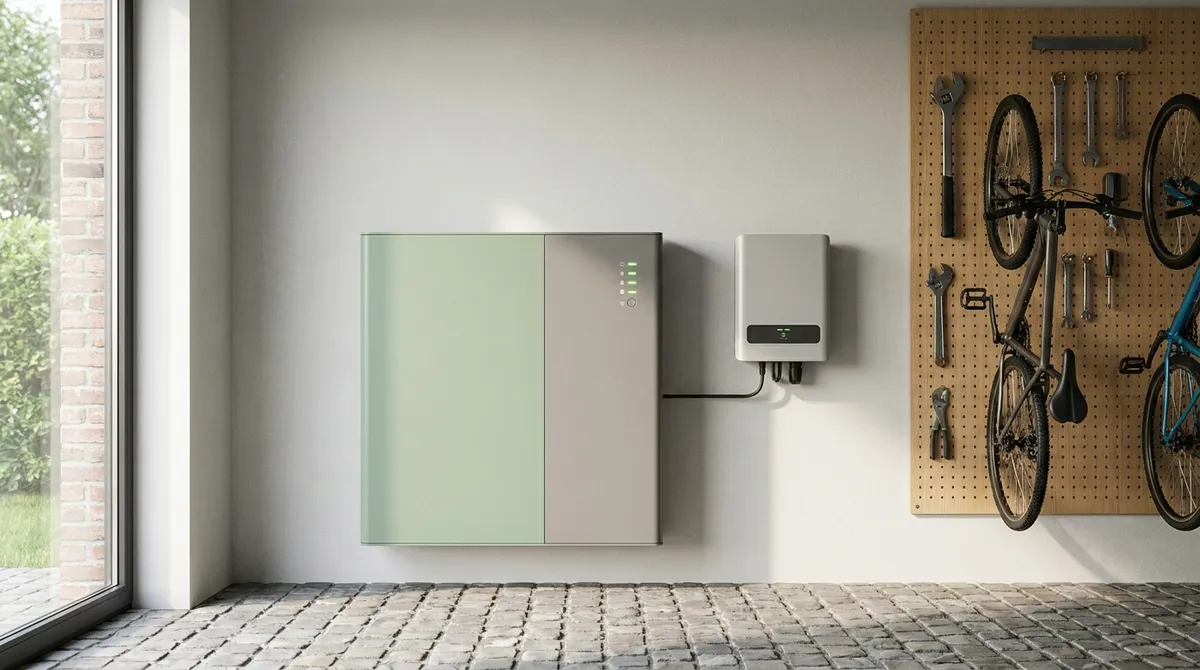
A lithium reserve installed at home that actually stores your surplus to release it in the evening — and to hold up during an outage.
Virtual battery A subscription serviceNo hardware: your surplus injected into the grid is credited by the supplier, who bills it back to you later.
The physical battery rests on something concrete: lithium cells, an inverter, sometimes a backup function. The virtual battery, on the other hand, stores nothing in your home — it’s an accounting entry that values your surplus on your bill. This distinction, which seems technical, changes everything the moment an outage strikes or the costs are added up over time.
The cost: investment versus subscription
The first instinct is to compare the price, but the two models can’t be measured the same way.
The physical battery requires an initial investment, generally between €4,000 and €7,000 depending on the installed capacity and the inverter chosen. Once fitted, it generates no recurring fees: the energy it stores is free, since it’s yours. Regional grants can also significantly lighten the upfront bill.
The virtual battery reverses the logic: zero installation cost, but a monthly subscription taken every month, sometimes topped up with fees on the energy returned to you. As long as you pay, the service runs; the day you cancel, you’re left with nothing. Over ten to fifteen years, the sum of the monthly payments can exceed the cost of a physical battery, without any asset belonging to you at the end of it.
Capacities, 2026 price ranges and regional grants: the benchmarks to budget for a physical battery, grant deducted.
See storage prices and grants →Self-consumption: who really uses their own energy?
This is probably the most misunderstood criterion. A battery is supposed to make you more independent from the grid — but the two solutions don’t achieve that in the same way at all.
The physical battery concretely increases your self-consumption. The energy produced during the day is stored and then genuinely released in the evening: in a well-sized installation, the self-consumption rate climbs to around 70%. You consume your own production at the moment you need it.
The virtual battery, on the other hand, changes nothing about when you consume. Your surplus goes onto the grid, and the energy “returned” later comes from that same grid. It’s an accounting offset mechanism: it can lighten the bill, but it doesn’t make you independent. In the evening, you remain a grid customer like any other.
This is the self-consumption rate achievable with a well-sized physical battery, versus unchanged real self-consumption with a virtual battery, which is merely a play of entries on your bill.
Backup during an outage: the decisive gap
On this point, there’s no comparison possible. The virtual battery depends 100% on the grid: as soon as an outage strikes, it goes down with it. You have no reserve available, since there’s no equipment in your home.
A physical battery, paired with a backup function, keeps powering your home during the failure. Fridge, lighting, internet box, basic heating: you keep the essentials until the power comes back. For anyone living in an area with frequent outages, or simply wanting peace of mind, this is often the argument that decides.
Subscription fees, dependence on the supplier, absence of backup: our breakdown of the virtual battery concept.
Read the full analysis →Lifespan and simplicity: an asset or a contract
A physical lithium battery is generally guaranteed for ten years and often lasts longer. It’s an asset attached to your home, which even increases its value. In return, it requires an installation, technical space and an upfront investment — so getting started is less immediate.
The virtual battery, for its part, wins on simplicity: no works, no space to plan for, a subscription in a few clicks. But its “lifespan” doesn’t exist in its own right: it’s a contract, valid as long as you stay with the supplier and as long as its pricing conditions suit you. A change of tariff or supplier, and the whole balance has to be reworked.
The head-to-head, criterion by criterion
To sum up, here’s how the two solutions split out on the five criteria that really matter when it’s time to decide.
| Criterion | Physical battery | Virtual battery |
|---|---|---|
| Cost | ≈ €4,000-7,000 to buy, then nothing | No investment, but a monthly subscription |
| Self-consumption | Real self-consumption ≈ 70% | Accounting offset, consumption unchanged |
| Backup | Holds during an outage (with backup) | Goes down with the grid |
| Lifespan | Guaranteed ≈ 10 years, a durable asset | A contract, valid as long as you stay |
| Simplicity | Installation to plan for | Immediate subscription, zero hardware |
Which profile should choose what?
Neither one is “better” in the absolute: it all depends on your priorities.
- The physical battery is made for you if you want to maximise your self-consumption, gain independence, guard against outages and durably add value to your home — even if it means investing upfront.
- The virtual battery may suit you if you’re looking above all for simplicity, you don’t have space for equipment, and your supplier’s offer is genuinely advantageous once the fees are added up.
In many cases, the solar surplus deserves better than a simple play of entries: storing it for real means keeping control of it. If you’re still hesitating on the capacity to aim for, our dedicated guide helps you size the right reserve.
Capacity in kWh, inverter compatibility and consumption profile: the benchmarks to choose a physical battery of the right size.
Size my battery →To set this choice within the full range of energy storage solutions, or to explore all the home battery options, our guides round out this straightforward comparison.
The recap in 30 seconds
- Physical battery — lithium equipment in your home, ≈ €4,000-7,000, real self-consumption ≈ 70%.
- Virtual battery — a subscription service, with no hardware and no real independence.
- Power outage — only the physical battery (with backup) keeps the house powered.
- Cost — a one-off investment on one side, endless monthly payments on the other.
- When in doubt, personalised advice decides based on your consumption profile.
Guide verified in May 2026 · updated every year