« Ajout d'une batterie à notre installation solaire existante. Le dimensionnement était juste, on consomme désormais le soir notre propre énergie. »
Claire D.Wavre
Your panels already produce, but a large part of the energy goes back to the grid at off-peak hours? We add a battery to your existing installation to store that surplus and use it in the evening. First step: check the compatibility of your existing inverter.
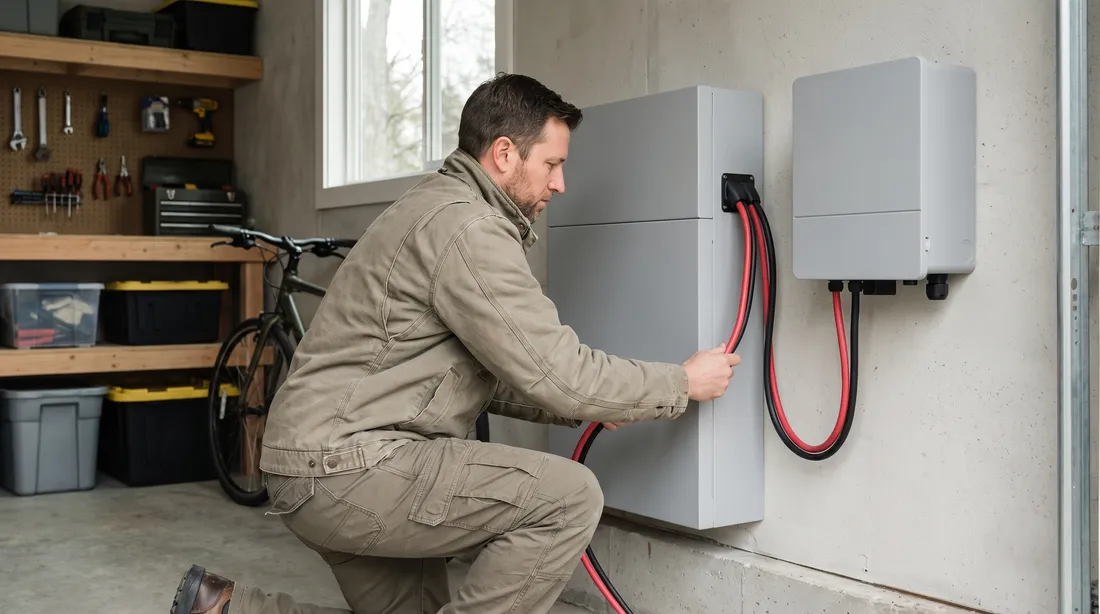
Adding a battery to an existing installation is not the same as a new fitting: everything starts from what is already there — inverter, cabling, electrical panel — which must first be audited.
Survey of your PV installation already in place: panel output, inverter model, electrical panel and meter. This is the basis of any battery-addition study.
Hybrid inverter already in place? Adding is simple. Otherwise, we couple the battery on AC or install a dedicated battery inverter, without touching your PV inverter.
We calculate the useful capacity (5, 7 or 10 kWh) based on your evening consumption and your production surplus, so as not to oversize unnecessarily.
Mounting of the battery, connection to the panel and to the inverter, integration with the meter — cleanly, on an installation that is already running.
Setting of the charge/discharge thresholds and activation of the monitoring: you see in real time what is stored, consumed and fed back.
Bringing the protections up to standard (circuit breakers, emergency cut-off, earthing) for a compliant and safe addition to your existing installation.
We analyse your existing installation and your inverter to determine the addition solution: hybrid extension, AC coupling or dedicated battery inverter.
A clear proposal with the recommended capacity, the coupling mode and the all-inclusive price — equipment, fitting and connection.
Fitting of the battery and connection to your installation in place, keeping production downtime to a minimum.
Setting, charge/discharge tests, start-up of the supervision and explanation of the self-consumption follow-up.
It all depends on the inverter already installed. If it is hybrid, we simply add the battery on the dedicated terminal. Otherwise, we couple the battery on AC via a dedicated battery inverter, without replacing your existing PV inverter.
A battery stores what your panels produce during the day to release it in the evening. We first check whether your inverter allows it.
It depends on the model. A hybrid inverter directly accepts the addition of a battery on its dedicated terminal. A classic photovoltaic inverter stays compatible via AC coupling: we then add a separate battery inverter. The feasibility study decides based on your exact equipment.
Not necessarily. If your inverter is hybrid, no change is required. If it is not, we keep your PV inverter and add a dedicated battery inverter with AC coupling. Full replacement of the inverter is only considered in rare cases, and always after costing.
For a household that mostly consumes in the evening, a battery of 5 to 10 useful kWh covers most night-time needs. We size it according to your real consumption and your production surplus to avoid oversizing, which needlessly lengthens the return on investment.
By raising self-consumption from about 35% to 70%, the battery clearly reduces the energy bought from the grid in the evening. Profitability depends on your consumption profile, the price of electricity and the feed-in tariff. The quote includes a costed estimate of the annual gain.
| Service | Range | Typical lead time |
|---|---|---|
| Adding a 5 kWh battery (LFP lithium) | 4 000 – 5 000 € | By study |
| Adding a 7 kWh battery (LFP lithium) | 5 000 – 6 000 € | By study |
| Adding a 10 kWh battery (LFP lithium) | 6 000 – 7 000 € | By study |
| Dedicated battery inverter (AC coupling) | from 1 200 € | If inverter not hybrid |
5.0/5 · 1verified reviews
« Ajout d'une batterie à notre installation solaire existante. Le dimensionnement était juste, on consomme désormais le soir notre propre énergie. »
Tell us your inverter model: we check compatibility and propose the right battery, with a clear price and the estimated gain.