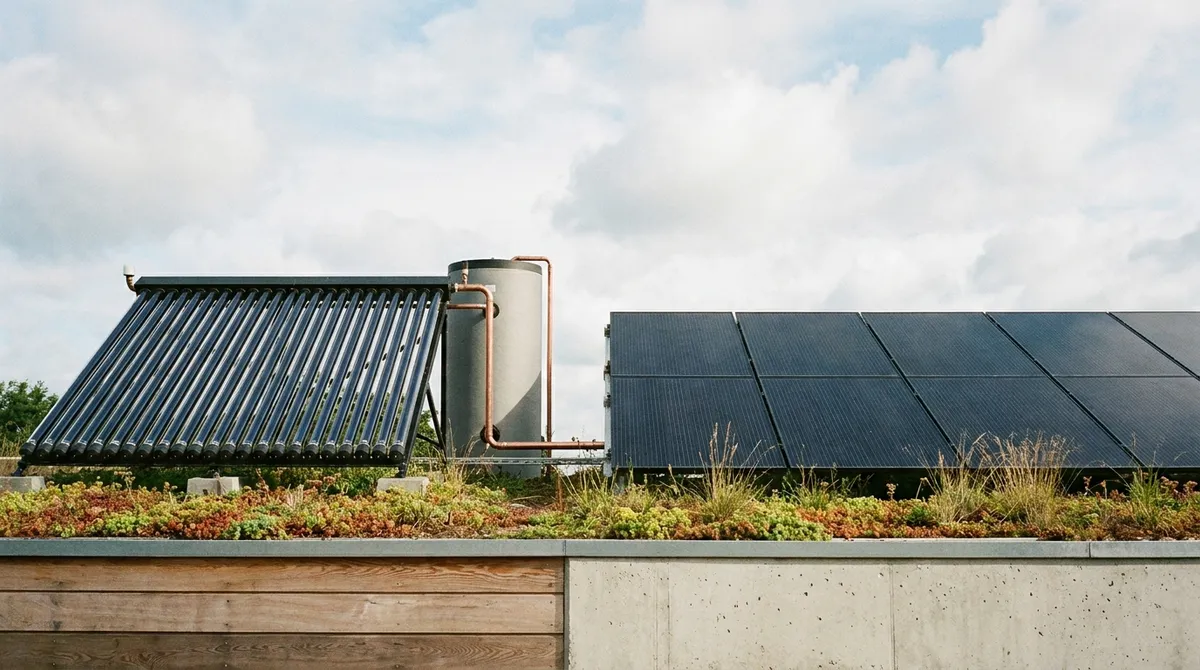
“I want to install solar panels”: behind this sentence in fact hide two quite distinct technologies, often confused. Solar thermal heats water; solar photovoltaic produces electricity. Choosing one for a need that belonged to the other means investing wide of the mark. This guide sets things straight so you know exactly which one suits your situation.
Two technologies, two different energies
The misunderstanding comes from the word “solar”, which covers two families of installation with no technical link between them. The distinction holds in one sentence: one captures the sun’s heat, the other captures its light.
A solar thermal collector circulates a heat-transfer fluid behind an absorbing surface. This fluid heats up in the sun, then passes its heat to a tank: your domestic hot water, or a heating top-up. No electricity is produced at any moment.
A photovoltaic panel, on the other hand, is made of silicon cells that convert light directly into electric current. This current powers your home — appliances, lighting, charging a car or a heat pump — and the surplus can be stored in a battery or injected into the grid.
Collectors heat a fluid to supply your domestic hot water, or even a heating top-up. Very high efficiency in heat.
Photovoltaic Produces electricityCells turn light into current for the whole house. The reigning technology of residential.
Hybrid (PVT) Both at onceA single panel produces electricity and recovers the heat it gives off. Ideal when roof surface is tight.
Solar thermal: heating water, efficiently
Solar thermal has a clearly defined playing field: domestic hot water. A solar water heater covers a good part of a household’s annual hot water needs, the rest being provided by a top-up (boiler, electric element, heat pump). Some more ambitious systems also contribute to heating, but hot water remains their main use.
Its strengths
- Very high conversion efficiency: a collector turns a large share of the solar energy it receives into useful heat.
- Reduced roof surface: a few square metres are enough to cover a family’s hot water.
- A proven technology, simple in principle, that targets precisely one heavy consumption item.
Its limits
The use is single-function: thermal produces only heat, and only for water. In summer, production can exceed needs (overheating to manage); in winter, the top-up remains essential. Above all, since heat pumps and photovoltaic have matured, many households prefer to produce electricity and heat the water some other way.
Photovoltaic: electricity for the whole house
Photovoltaic has established itself as the reigning technology of residential, and for good reason: the electricity it produces is used for everything. Every self-consumed kilowatt-hour is a kilowatt-hour you don’t buy from the grid, on an item — the electricity bill — that only keeps climbing.
Its strengths
- A versatile energy: lighting, appliances, vehicle charging, heat pump, all benefit from it.
- The surplus is not lost: it is stored in a battery or injected into the grid.
- A scalable installation, sized according to your consumption and the available roof surface.
Its limits
The conversion efficiency is more modest than that of thermal — but the comparison is misleading, since we are not talking about the same energy. The real challenge of photovoltaic is self-consumption: the more you consume your own production at the moment it is available, the more profitable the installation.
This is the share of solar production a household can aim to self-consume by managing its usage and adding a battery — the decisive lever of a photovoltaic installation’s profitability.
Payback period, annual savings and grants: the honest calculation to find out what a photovoltaic installation really earns you.
See the 2026 profitability guide →Hybrid (PVT): both on a single panel
When roof surface is tight and you want both electricity and hot water, the hybrid panel — or PVT — layers the two technologies. Beneath the photovoltaic cells, a circuit recovers the heat given off by the panel, which has a double advantage: you produce hot water and you cool the cells, which perform better when they don’t overheat.
It is an appealing solution, but it remains more expensive and more complex to install. It is justified above all on projects where every square metre of roof counts, or when you want to maximise the value of a small, well-exposed surface.
How to choose according to your need
Rather than looking for “the best” panel in the absolute, start from what you want to cover. Three scenarios are enough to bring out an obvious answer.
- Are you aiming above all at your electricity bill? Photovoltaic is the clear choice: it covers all your electrical uses and remains the most versatile technology.
- Do you use a lot of hot water (large family, regular use)? Thermal targets precisely that item — but compare it with a heat pump powered by photovoltaic, often more flexible.
- Small roof, dual goal of electricity + hot water? Hybrid PVT is worth studying, provided you accept an extra cost.
In today’s residential, the winning combination is frequently photovoltaic + heat pump: your panels produce the electricity, and the heat pump uses it to heat the house and the water. You thus cover both heat and current with a single renewable energy source, without multiplying installations on the roof.
Powered by your own panels, a heat pump heats the house and the water for a fraction of the cost of conventional heating.
Discover the heat pump →And what about the grants?
The framework of regional support evolves regularly, and it differs depending on whether you install thermal, photovoltaic or a heat pump. In Belgium, photovoltaic benefits above all from the valuation of self-consumption and, depending on the region, from investment support mechanisms; the solar thermal water heater and heat pumps qualify for their own grants. Before deciding, it is worth costing each scenario grant deducted — that is often where the trade-off is settled.
Installation: a common point
Whatever technology you choose, the quality of the installation accounts for a large part of the result: orientation, tilt, shading, sizing against your real needs. A well-chosen panel that is poorly installed underperforms; honest sizing, matched to your consumption, is worth more than an oversized installation sold by the square metre.
Roof survey, sizing, connection and commissioning: the steps of a successful solar installation, with no nasty surprises.
See the installation guide →The 30-second recap
- Thermal — produces heat for domestic hot water, high efficiency but a single use.
- Photovoltaic — produces electricity for the whole house: the reigning technology of residential.
- Hybrid (PVT) — both on a single panel, relevant when roof surface is tight.
- The winning combination in 2026: photovoltaic + heat pump to cover both heat and current.
- When in doubt, a free study costs each scenario, grant deducted.
Guide verified in May 2026 · updated every year