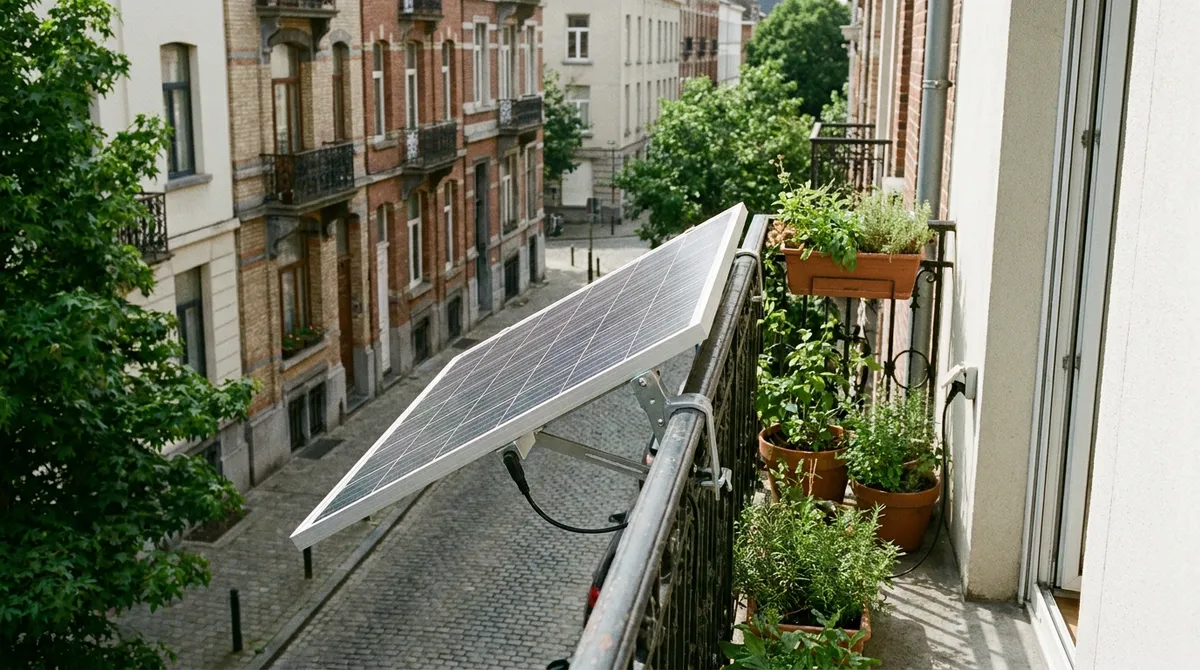
Producing a little solar electricity yourself without climbing onto the roof, without an electrician and without a big budget: that is exactly what the plug & play solar panel offers. The principle comes down to a single gesture — you plug it in, it produces. But behind that simplicity lie very real physical rules: a ready-to-plug kit doesn’t do everything, and knowing what it really does avoids disappointment. This guide explains how it works, its power, its expected output and who it suits.
The principle: a panel that plugs into a socket
A plug & play kit (also called a “ready-to-plug solar kit” or “balcony solar”) brings together in a single set everything that a classic installation spreads across a roof and an electrical panel:
- one or two photovoltaic panels, in standard format;
- a built-in micro-inverter, fixed to the back of the panel;
- a cable ending in a classic plug, to connect to a household socket.
The panel captures the light and produces direct current. The micro-inverter immediately converts it into 230 V alternating current, identical to the grid’s. Once the plug is connected, this electricity flows through your home installation and powers the appliances running at that moment first: the fridge, the internet box, standby modes, a computer. You draw that much less from the grid, and your meter turns more slowly.
The whole difference from a fixed installation lies there: no connection to the panel, no work on the roof, no electrician required. It is a device you install as you would a washing machine.
This is the typical power of a plug & play kit, that is one to two panels. By combining several kits, you reach at best ~2 kWp — beyond that, you switch to a fixed installation.
Where to install it?
The kit doesn’t need a roof. You place it where it catches the sun and can be safely fixed:
- on a balcony railing or a terrace;
- in a garden, on a ballasted or staked tilted support;
- against a façade or a well-exposed wall;
- on a shelter, a carport or a shed.
As with any solar installation, orientation matters: due south with a tilt of around 30 to 35° gives the best efficiency, but a south-east or south-west remains perfectly fine. A vertical mount on a balcony produces a little less, which is normal and predictable.
How much does it really produce?
This is the question that separates the promise from the result. In Belgium, a solar installation produces roughly 850 to 950 kWh per kWp per year, depending on orientation and shading. A plug & play kit follows the same rule.
In practice, a well-exposed 800 W kit produces on the order of 700 to 750 kWh over the year. That is far from covering a whole house, but it is enough to absorb a good share of baseline consumption: those appliances that run constantly without you thinking about it. The gain is real provided this production is consumed on the spot, at the moment it is produced — hence the value of running the big appliances (washing machine, dishwasher) during the day.
If the goal is to cover the bulk of your consumption, a fixed installation of several kWp fitted by a professional is a step up in scale — production, grants and payback included.
See solar panel installation →Who is plug & play made for?
The ready-to-plug kit answers very specific situations, where a fixed installation would be disproportionate or impossible.
The tenant and the apartment
This is probably its best ground. No roof available, no heavy works to negotiate with the owner: the kit goes on a balcony, produces for the length of the lease, then leaves with you if you move. A reversible panel, in short.
The small budget and the trial
For a few hundred euros, plug & play offers a first step towards self-production without the investment of a complete installation. It is also a good way to get familiar with solar before, possibly, moving on to a fixed roof installation.
A complement, not a replacement
For an owner already equipped, or planning to be, a kit can serve as a targeted top-up — for instance powering an isolated workshop or garden shed. But it comes as a complement to a solar approach, never as a replacement for a roof installation.
The limits to know before buying
Plug & play is honest as long as you don’t expect from it what it cannot do.
- A capped power. From 300 to 800 W per kit, ~2 kWp when combining — a fraction of a household’s needs, not their entirety.
- Not for the whole house. It reduces baseline consumption; it does not heat a home and does not power a heat pump.
- Production = immediate self-consumption. Electricity not consumed at that moment goes to the grid, without the valuation mechanism of a classic declared installation.
- Rules to respect. Plugging in a device that feeds current back is not entirely neutral as regards the grid operator and the meter: that is a point to check, separate from the technical operation.
Declaration to the grid operator, type of meter, electrical standards: Belgian regulation broken down, separately from the technical question.
Read the regulation guide →Plug & play or fixed installation: don’t confuse the two
Both come under solar, but they don’t play in the same league. Plug & play aims at simplicity and mobility on a small power; the fixed installation aims at covering the needs of a household over the long term, with a production of several kWp, professional roof mounting and access to grants. One is not a budget version of the other: they are two answers to two different needs. To compare the two worlds in detail, the solar panels hub brings together sizing, grants and payback.
And if the real question is “is it worth it for me?”, that is a subject of its own: our guide plug & play review settles the real payback without the hard sell, while the legality in Belgium guide covers the rules to respect.
The 30-second recap
- A plug & play kit = a panel + a micro-inverter, plugged into a simple socket.
- Typical power 300–800 W, up to ~2 kWp when combining several kits.
- It reduces baseline consumption — it does not cover the whole house.
- Ideal for the tenant, the apartment, the small budget or as a complement.
- Installed without an electrician; legality and reviews are covered in our dedicated guides.
Guide verified in May 2026 · updated every year