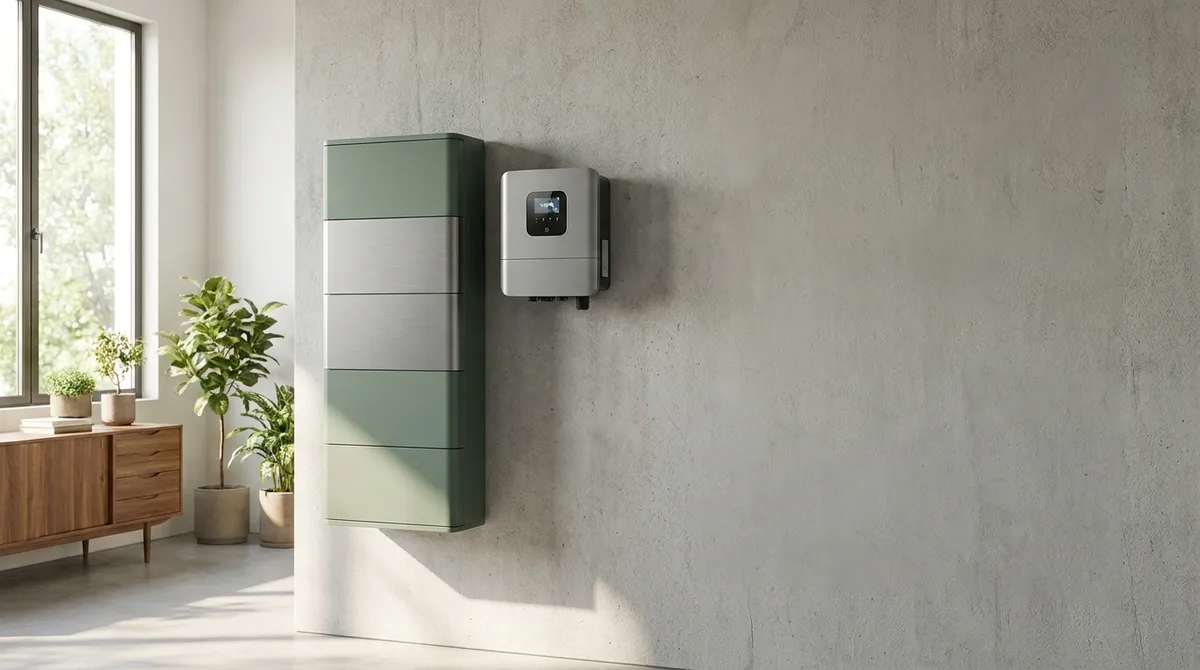
Five years ago, the answer was simple: without a specific grant, a battery struggled to pay for itself, because the grid played the role of storage for free. The meter ran backwards, your midday surplus erased your evening consumption, and every kWh injected was worth exactly one kWh drawn. That world no longer exists for new installations. In 2026, the scenery has changed — and with it, the place of the battery in a solar project. This guide takes stock of what has shifted. For the fundamentals of storage, refer to the guide Do you need a battery for your solar panels?; here, we talk about what’s current.
What has really changed in 2026
Three developments, independent but converging, explain why the question is posed differently today.
The surplus no longer erases consumption one for one. Injecting pays little, buying back costs a lot.
Prosumer tariff In forceThe grid usage tied to your installation is billed. The less you exchange with the grid, the better.
Cheaper batteries 2026The price per kWh stored is falling and 6% VAT on renovation brings the break-even point closer.
The end of net metering
This is the most structural change. For recent installations, the smart meter separately measures what you draw and what you inject. Your daytime production no longer cancels out, kilowatt-hour for kilowatt-hour, your evening consumption. In concrete terms, the surplus you send back to the grid is bought from you at a modest injection rate, whereas the electricity you buy back after dark is billed at the full price. The grid is no longer a free battery: it becomes a commercial partner, and the exchange rate is unfavourable.
The prosumer tariff, now unavoidable
The prosumer tariff bills the use your installation makes of the distribution grid. It applies regardless of the battery question, but it changes the equation: the more energy you exchange with the grid (injection by day, drawing in the evening), the heavier this usage weighs. A battery that keeps your surplus at home reduces these back-and-forths — it does not erase the prosumer tariff, but it limits its reach. The mechanism is explained in detail on our prosumer tariff page.
More affordable batteries
Good news to finish on: the hardware has come down in price. The ongoing drop in lithium cell prices, combined with sharper competition between manufacturers, has pushed down the price per kWh stored in 2026. Add the reduced 6% VAT on renovation for homes more than ten years old, and the threshold at which a battery becomes profitable has moved markedly closer compared with three or four years ago.
The injection / purchase gap: the heart of the calculation
It all comes down to one figure, or rather to the gap between two figures.
In 2026, you inject your surplus at around €0.05/kWh but you buy back your evening electricity at around €0.35/kWh. Every kilowatt-hour you manage to self-consume instead of injecting is therefore worth far more than what the grid would have paid you for it.
This gap is the real reason a battery makes sense in 2026. As long as net metering applied, it didn’t matter when you consumed: the energy was “stored” on the grid and taken back later at equal value. Now, the time of day matters. The surplus produced at midday, if you do nothing with it, leaves at €0.05/kWh; the same kilowatt-hour stored then consumed in the evening saves you from buying one back at €0.35/kWh. The battery does not “produce” energy: it shifts your consumption to make it coincide with your production. It is this shift that creates the value.
“In 2026, a battery is no longer about producing more, but about consuming at the right time — and that is precisely where the saving lies.
Should you rush, though?
No — and it’s important to say so clearly, contrary to any sales pitch. A battery is not universally profitable, even in 2026. Everything depends on your consumption profile and your actual surplus.
- A household often away during the day, consuming mostly in the evening, produces a lot of unused surplus: this is the profile that benefits the most from a battery.
- A household that already self-consumes a lot (remote work, a car charged during the day, smart-managed appliances) gains less from storage, since it already consumes its production directly.
- The size of the installation matters too: without significant surplus, there is nothing to store, and the battery stays empty half the time.
Before any purchase, the right reflex is therefore to measure your surplus and compare your profile against the 2026 tariffs. That is exactly what a figures-based simulation does.
Consumption profile, installation size, surplus and 2026 tariffs: our simulator calculates your payback time with and without a battery, in just a few minutes.
Run the simulation →And what about the grants?
The framework of grants changes from one year to the next, and 2026 is no exception. Depending on the region, support schemes for installation and storage have been adjusted: some direct grants have given way to targeted schemes, others remain conditional on performance criteria. Rather than quoting an amount that would be out of date by the next quarter, keep the principle in mind: a storage grant directly improves a battery’s payback time, and it must be checked at the precise moment of your project. We keep these conditions up to date and factor them into every quote.
To place the battery within the overall economics of your installation — production, self-consumption, grants and payback time — the guide Solar profitability in 2026 gives the complete, up-to-date picture.
Choosing the right sizing
A battery that is too small lets surplus slip away; a battery that is too large sits half empty and never pays for itself. The right sizing aims to cover your evening and night-time consumption with the surplus actually available — no more, no less. It is a technical trade-off made from your readings and your installation, which we detail on the home battery page, capacities and connection included.
The 2026 recap in 30 seconds
- Net metering has disappeared for new installations: the surplus no longer erases consumption.
- You inject at ≈ €0.05/kWh but buy back at ≈ €0.35/kWh: self-consuming becomes far more profitable.
- The prosumer tariff rewards those who exchange little with the grid — and the battery helps with that.
- Batteries fell in price in 2026 (price per kWh + 6% VAT on renovation): the break-even point is getting closer.
- A battery is not profitable for everyone: run a simulation based on your profile before deciding.
Guide verified in May 2026 · updated every year